

The Missing Link in Financial Planning Part 7
July 1, 2026
THE MISSING LINK IN FINANCIAL PLANNING – Part 9
July 14, 2026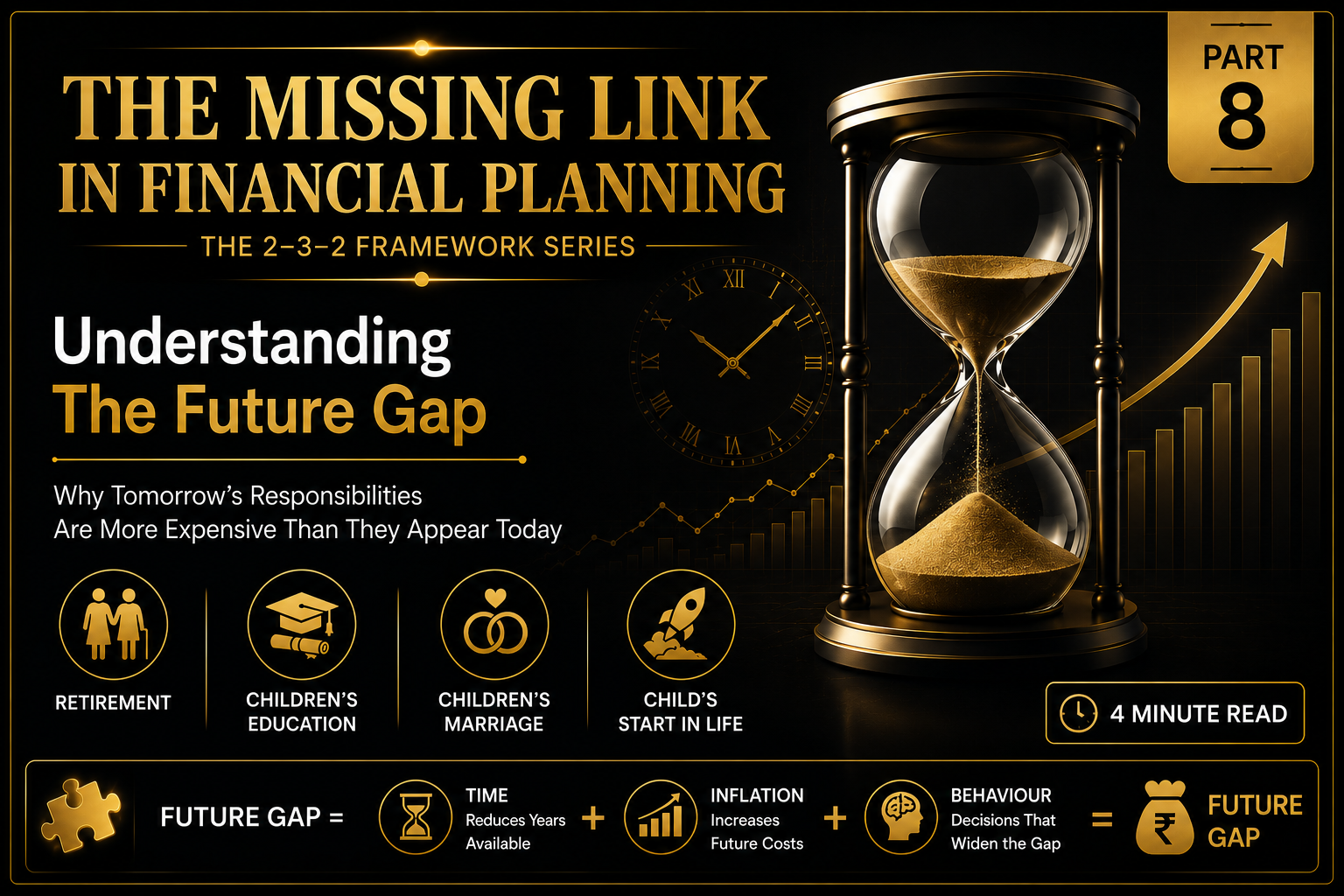
Understanding the Future Gap
“Why Tomorrow’s Responsibilities Are More Expensive Than They Appear Today”
In the earlier parts of this series, I introduced the role of discipline and continuity for compounding to work, then explored the Stability Layer as a missing link in financial planning, then I showed the difference between Investment Volatility Risk and Behavioural Discipline Risk, then I introduced the 2–3–2 Framework consisting of 2 Gaps, 3 Layers, and 2 Risks after which I introduced the two financial gaps every family must fund — the Present Gap and the Future Gap. Next I discussed Need Goals and Want Goals.
In the previous article, we explored the Present Gap—the financial shortfall a family faces if income stops today.
In this article, we move to the second gap—the Future Gap.
What is the Future Gap?
The Future Gap is the shortage of capital required to fund a family’s future Need Goals while maintaining its financial continuity.
In simple words,
If retirement arrived tomorrow, or your child received admission for higher education next year, would your existing investments be enough to meet those responsibilities?
Unlike the Present Gap, which may become visible overnight, the Future Gap grows quietly over many years.
People don’t fail because they earn too little.
They fail because they underestimate the future cost of today’s responsibilities.
Tomorrow Never Stops Coming
Whether we prepare or not,
- Retirement will arrive.
- Children will grow up.
- Education costs will increase.
- Marriage expenses will rise.
- Healthcare will become more expensive.
Ignoring these responsibilities does not make them disappear.
It simply makes them more expensive.
Time and Inflation: Silent Wealth Destroyers
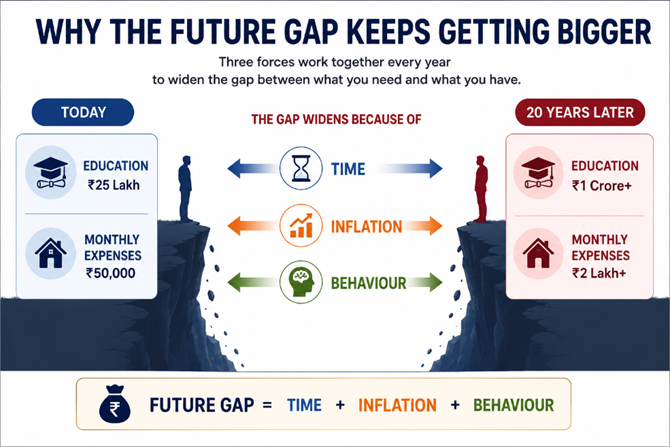
The Future Gap grows because of two invisible forces—time and inflation.
A child’s education costing ₹25 lakh today may cost over ₹1 crore twenty years later.
A family living comfortably on ₹50,000 per month today may require nearly ₹2 lakh per month after retirement to maintain the same lifestyle.
There are no warning signals.
No reminders.
No immediate pain.
Inflation silently widens the Future Gap every year.
A Real-Life Example
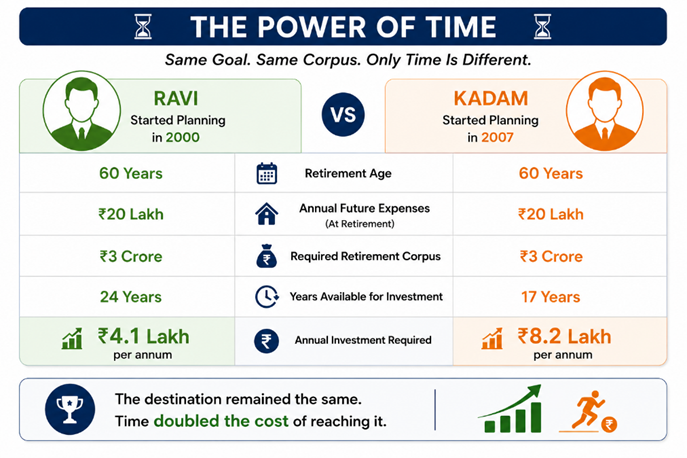
Many years ago, I prepared retirement plans for two close school friends—Ravi and Kadam.
Both were of similar age, earned comparable incomes, enjoyed similar lifestyles and wanted to retire at the age of 60.
Ravi started planning in the year 2000.
Kadam postponed planning for seven years and finally began in 2007
When Kadam finally started, the retirement goal had not changed.
The required retirement corpus had not changed.
The destination remained the same.
Time doubled the cost of reaching it.
Behaviour Widens the Future Gap
Inflation is only one part of the story.
Our behaviour widens the Future Gap even faster.
Every time we:
- Delay starting investments
- Interrupt long-term savings
- Withdraw money meant for future goals
- allow lifestyle inflation to replace disciplined investing
- Prioritise Want Goals over Need Goals
We increase the amount we must save later.
The Future Gap grows because three forces work together:
Future Gap = Time + Inflation + Behaviour
The Future Gap Is More Than Retirement
Many people think only about retirement.
In reality, the Future Gap includes every major Need Goal, such as:
- Retirement
- Children’s higher education
- Children’s marriage
- Children’s financial start in life
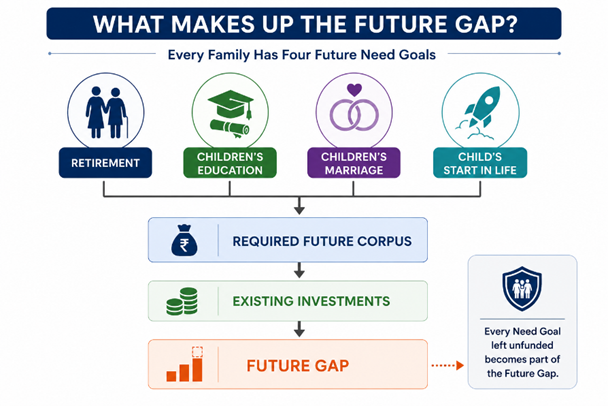
Each goal requires capital.
Each becomes more expensive with time.
Calculating the Future Gap
The calculation is straightforward.
Required Future Corpus
Less
- Future value of existing investments
- Provident Fund accumulations
- Insurance maturity values
- Other investments already earmarked for these goals
= Future Gap
Only after this calculation can a family know whether it is truly on track to achieve its long-term goals.
Financial Continuity Begins Today
The Future Gap is not created overnight.
It is created one postponed decision at a time.
Every year we delay planning…
Every investment we interrupt…
Every Want Goal that replaces a Need Goal…
quietly widens the gap between the future we hope for and the future we are actually funding.
Time doesn’t change your dreams.
Time changes the price of achieving them.
Financial continuity begins long before retirement arrives.
It begins with the decisions we make today.
Coming Next…
If we understand both the Present Gap and the Future Gap and what structures help us bridge these gaps?
In the next article, we begin exploring the Protection Layer, the first of the three layers in the 2–3–2 Framework, and discover why every successful financial plan must first protect today’s financial foundation before building tomorrow’s wealth.
If you have not read my Previous Blogs then here is the Link
next blog