
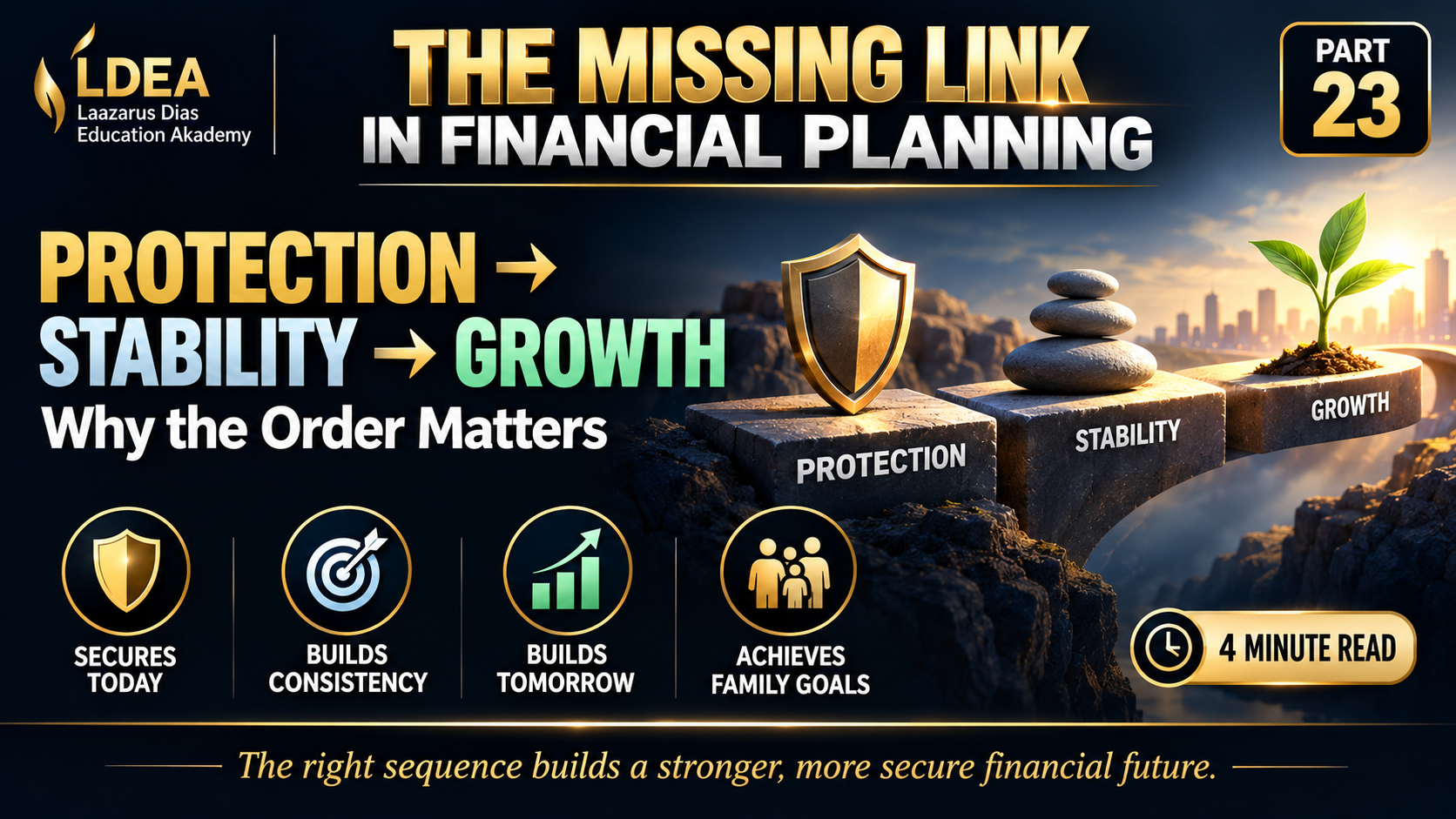
THE MISSING LINK IN FINANCIAL PLANNING — PART 23
October 21, 2026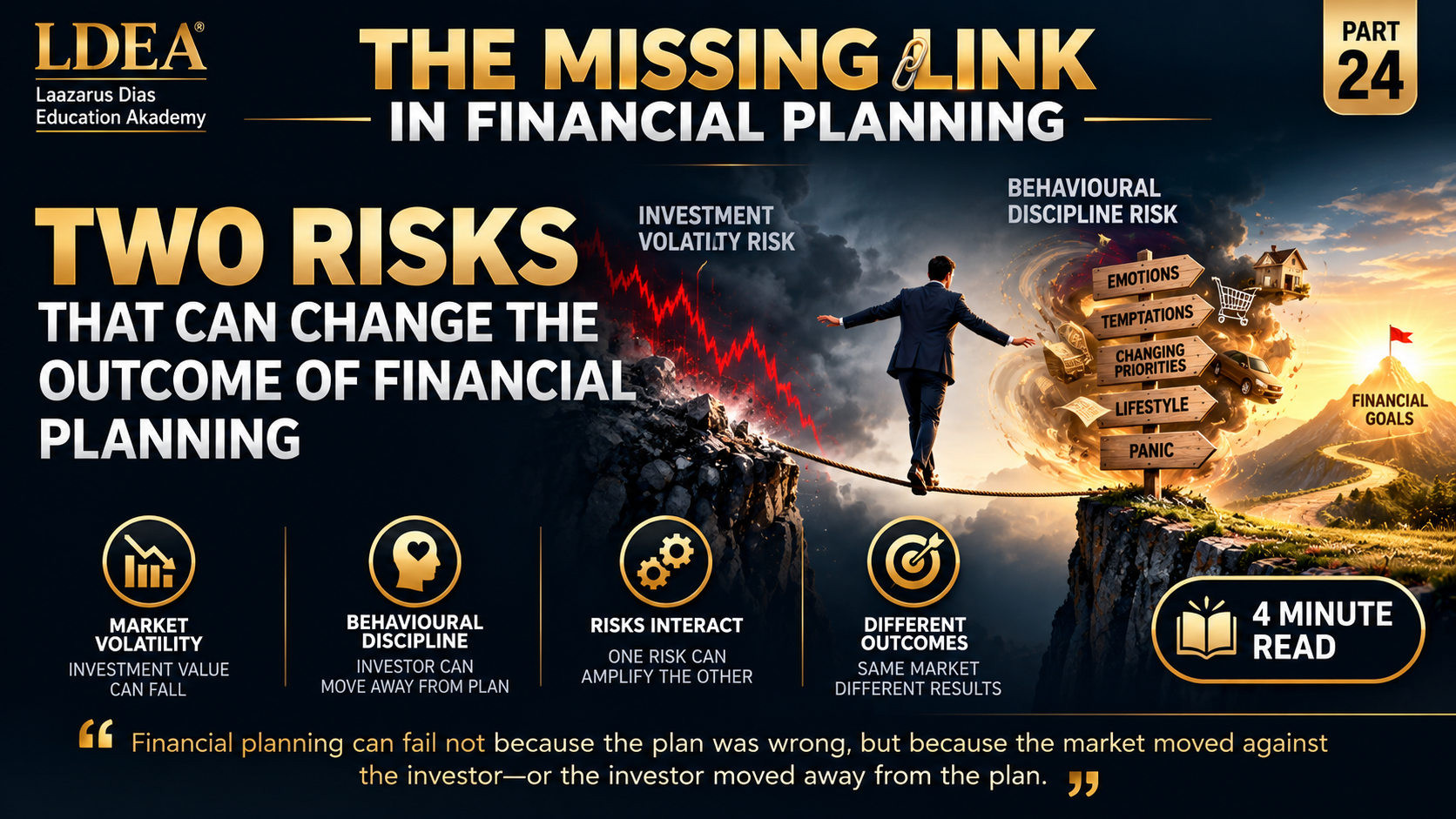
Two Risks That Can Change the Outcome of Financial Planning
Over the past 23 articles, we have explored the two financial gaps every family needs to address: the Present Gap and the Future Gap. We have also introduced the three layers—Protection, Stability and Growth—that provide structure to a financial plan.
But even a well-designed plan can fail if two critical risks are not addressed: Investment Volatility Risk and Behavioural Discipline Risk.
Let us understand how these risks can change the final outcome.
A Good Plan Does Not Guarantee a Good Outcome
Financial planning is ultimately about helping a family achieve its goals at the right time, with the required financial resources.
A plan may be carefully prepared, with future needs estimated and inflation accounted for. Yet, these calculations are only the beginning. A family’s financial journey can span several decades, during which circumstances, priorities and behaviour may change.
The real challenge is not merely creating a plan. It is staying on course long enough to achieve the desired outcome.
Two Risks, Two Different Challenges
Investment Volatility Risk arises when market fluctuations affect the value of investments. Appropriate asset allocation and diversification can help manage this risk.
Behavioural Discipline Risk arises when investors deviate from their plans because of emotions, changing priorities, lifestyle choices or unexpected temptations.
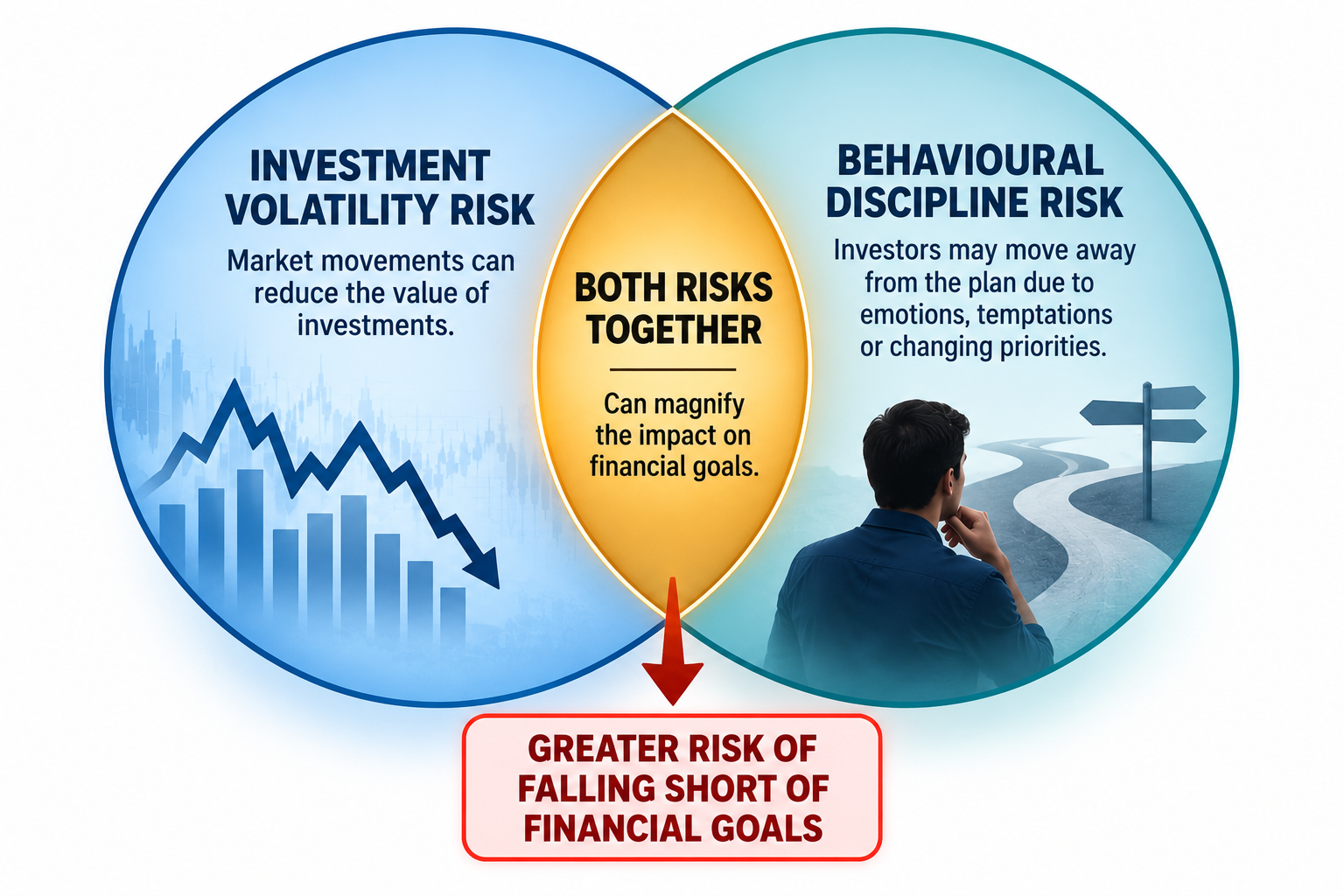
These risks can also interact. When represented as two circles, Investment Volatility Risk and Behavioural Discipline Risk can overlap, illustrating that the two risks can exist simultaneously and influence each other. An investor may face market fluctuations while also struggling to remain committed to the financial plan. In the overlapping area, both risks operate together, potentially magnifying their impact on the final outcome. This is why financial planning must address both risks independently as well as recognise how they can combine to affect the achievement of financial goals.
A market fall may be temporary, but if an investor panics and withdraws investments at the wrong time, the damage can become permanent.
Similarly, an investor may have an appropriate portfolio but still fall short of financial goals by stopping investments or diverting money towards other priorities.
Traditional risk profiling helps determine how much market risk an investor may be comfortable taking. But it does not necessarily reveal whether that investor will remain committed to the plan when circumstances change.
Consider the experience of two friends.

The Story of Mr. Anil and Mr. Shanbaug
Mr. Anil and Mr. Shanbaug had both prepared financial plans for their retirement.
Based on their investment risk profiles, Anil was classified as conservative, while Shanbaug was classified as aggressive. Their investments were structured accordingly.
When the markets corrected, Anil was relieved that his conservative approach had protected him from taking excessive risk. He was content with relatively modest returns.
Shanbaug, meanwhile, had accepted greater market risk in pursuit of higher returns.
As they approached retirement, however, an unexpected difference emerged. Anil was close to accumulating the corpus he needed, while Shanbaug was falling short.
Both were surprised. Shanbaug had taken greater investment risk and had expected better returns. What had gone wrong?
It turned out that midway through his investment journey, Shanbaug had stopped investing to purchase a much bigger house. He considered it a better investment. However, the house was also his home—a consumption asset that could not easily be liquidated to fund his retirement without disrupting his lifestyle.
His investment plan had been interrupted by a change in priorities.
His investment risk had been assessed, but his behavioural discipline risk had not.

Managing Both Risks for a Better Outcome
Anil and Shanbaug’s experience highlights an important lesson: choosing investments according to a risk profile is only one part of financial planning.
Investment Volatility Risk requires an appropriate investment strategy. Behavioural Discipline Risk requires a financial structure that helps investors remain consistent and resist unnecessary deviations from their plans.
Neither approach can replace the other.
A successful financial plan must consider not only how money is invested, but also how the investor is likely to behave throughout the journey.

Financial planning can fail not because the plan was wrong, but because the market moved against the investor—or the investor moved away from the plan.
In our next article, we will explore the 4C’s—Creation, Consumption, Continuation and Conservation—and how they contribute to a more complete approach to financial planning.
If you’re reading this Blog series for the first time, please click the link below to go to the first article, then read each subsequent blog, with links provided below each one.