

THE MISSING LINK IN FINANCIAL PLANNING – Part 22
October 14, 2026
Protection → Stability → Growth: Why the Order Matters
Over the past 22 articles, we have explored the two financial gaps every family needs to address: the Present Gap and the Future Gap.
We have also examined the two risks that can prevent a financial plan from delivering its intended outcome: Investment Volatility Risk, arising from market fluctuations, and Behavioural Discipline Risk, arising from emotions, habits and changing priorities.
The three layers—Protection, Stability and Growth—provide the structure to address these gaps while managing the risks that can derail the financial journey.
But all three layers are not equally urgent. The order in which they are planned and implemented can make the difference between having a financial plan and actually achieving its objectives.
What Does Each Layer Address?
- Protection Layer: Addresses the Present Gap by safeguarding the family’s financial continuity against uncertainties.
- Stability Layer: Supports financial continuity and future goals through suitable commitment-oriented investments, with allocation depending on the family’s needs and behavioural discipline.
- Growth Layer: Primarily addresses the Future Gap by building the corpus required for future goals.
Families often have limited surplus income and cannot fund every goal simultaneously. They must therefore prioritise how available resources are allocated.

A Family Planning Example
Rajesh and Priya were a couple with two school-going children, a home loan and plans for their children’s higher education and retirement.
Their financial plan looked promising. They started investing for future goals, but most of their attention was on building wealth. They had not adequately protected the family’s income, and Rajesh frequently withdrew investments to fund unplanned expenses.
After a few years of planning, Rajesh was unable to earn for several months because of a serious illness. The family had to meet its household expenses and loan repayments while managing medical costs. Without adequate protection, they had to use investments earmarked for education and retirement.
Finally family recovered financially but they had to repeatedly divert their savings due to which their future goals remained underfunded.
They had sacrificed protection against today’s uncertainties due to which they had to live in constant fear of Rajesh ill health. Absence of the Protection layer may not just affect financially but also psychologically as it happened to Rajesh and Priya.
This is why the three layers must be designed together but prioritised carefully.

1. Protection First
The Protection Layer must receive priority because it addresses uncertainties that can arise at any time.
A family’s income may stop because of premature death, disability or another unforeseen event. If adequate provision has not been made, the family may be forced to compromise its lifestyle, borrow money or liquidate investments intended for future goals.
Unlike retirement or a child’s education, an unexpected event does not follow a predictable timeline. We cannot wait until the family has accumulated sufficient wealth before addressing this vulnerability.
Protection helps secure today’s financial continuity and provides the foundation on which the rest of the financial plan can be built.
Protect the family against what could happen today before concentrating on what it hopes to achieve tomorrow.
2. Stability Second
Once protection has been addressed, the next priority is to build a structure that helps the family remain committed to its financial plan.
Consider an investor who repeatedly interrupts investments, withdraws money for unplanned purchases or changes course whenever markets become volatile. Even a well-designed plan may fail if the investor cannot remain consistent over the years.
The Stability Layer helps address this challenge through suitable commitment-oriented or less readily accessible investments. Its weightage depends on the investor’s behavioural discipline.
A highly disciplined investor may need a relatively smaller Stability allocation. Someone who struggles with consistency may need a larger allocation to help protect money intended for important goals.
Long-term financial success depends not only on investment returns but also on the ability to remain invested and follow the plan.
The Stability Layer helps bridge the gap between knowing what to do and consistently doing it.
3. Growth Third
The Growth Layer builds the corpus required to achieve future financial goals, such as children’s education, retirement and other long-term aspirations.
These goals generally have identifiable timelines, giving families time to accumulate the required funds. Once immediate financial vulnerabilities have been addressed and an appropriate stability structure is in place, the Growth Layer can be designed to support these goals.
Investment selection and asset allocation within this layer depend on the investor’s investment risk profile, time horizon and financial circumstances. The balance between equity, debt and other suitable instruments must reflect these factors.
Growth remains essential, but pursuing higher returns without adequate protection or the discipline to remain committed can undermine the entire plan.
Growth builds tomorrow’s wealth; Protection and Stability help keep the journey on course.
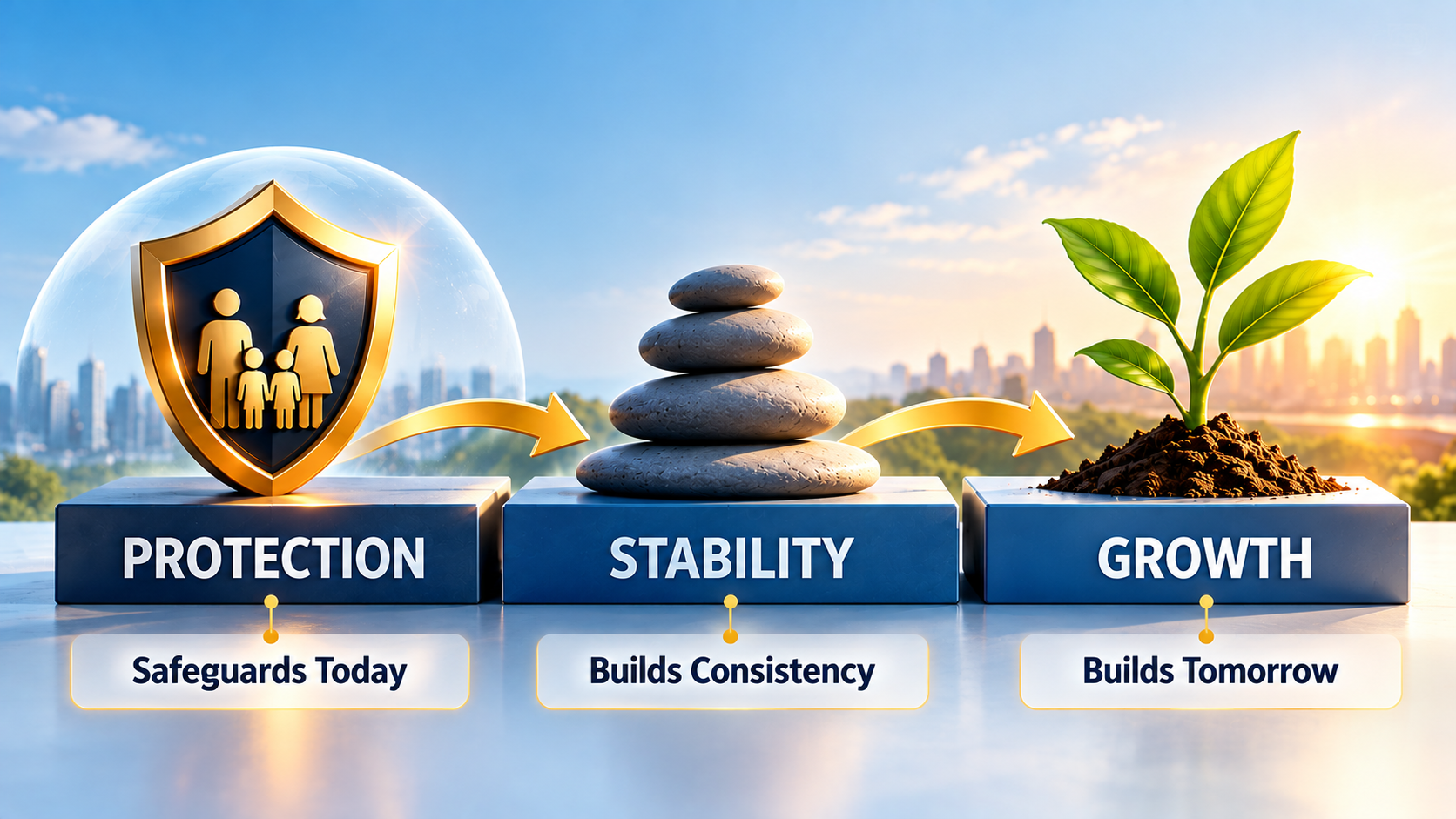
The Right Sequence Makes the Difference
Protection, Stability and Growth must work together, but they serve different purposes and address different vulnerabilities.
Protection → Stability → Growth
A successful financial plan is not simply about selecting suitable investments. It is about building the right structure, in the right sequence, for the family and its circumstances.
But even when the three layers are correctly designed, two risks can still influence the final outcome.
In the next article, we will examine Investment Volatility Risk and Behavioural Discipline Risk, and understand how they can affect the success of a financial plan.
If you’re reading this Blog series for the first time, please click the link below to go to the first article, then read each subsequent blog, with links provided below each one.