
THE MISSING LINK IN FINANCIAL PLANNING – Part 14
August 19, 2026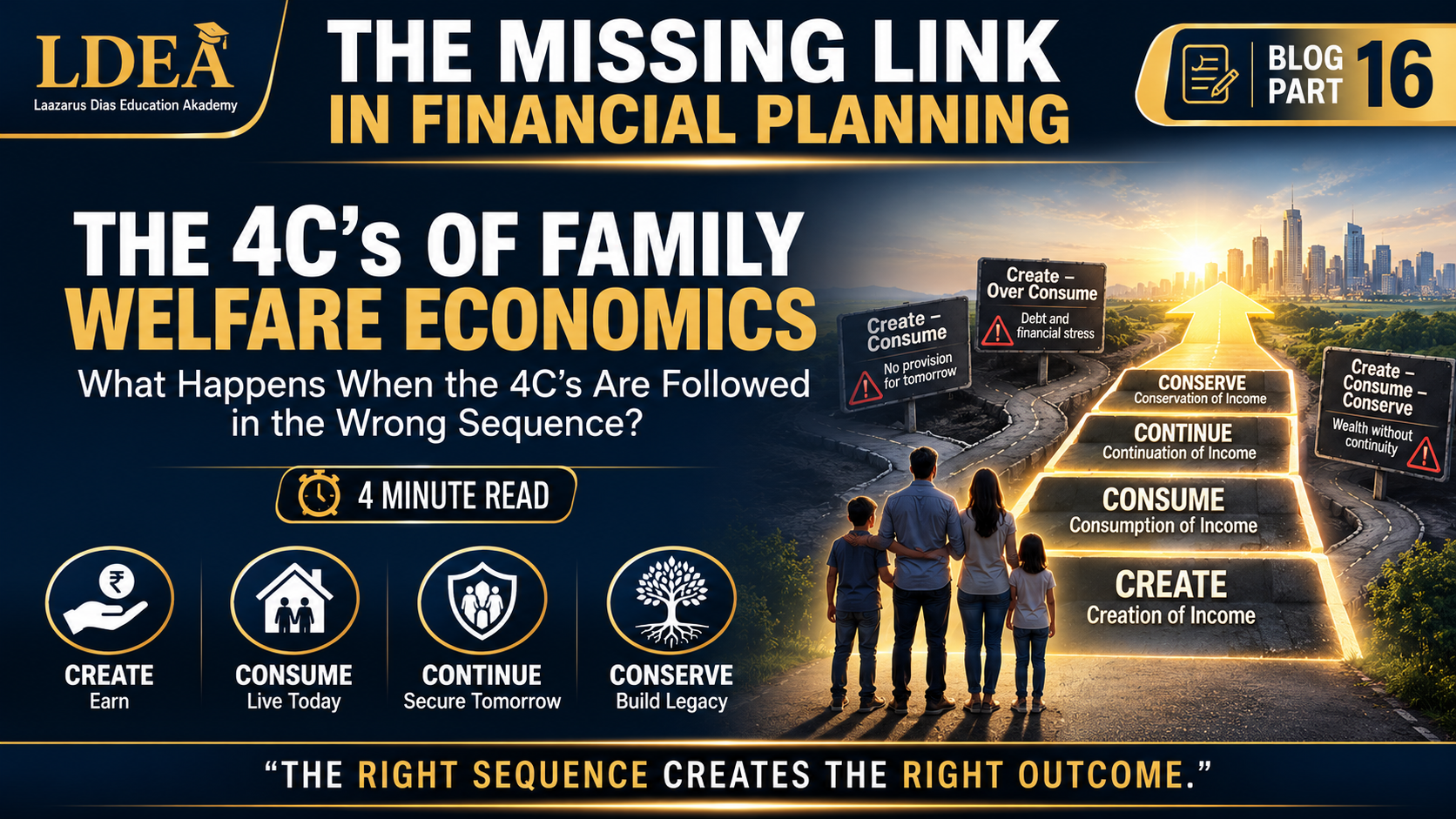
THE MISSING LINK IN FINANCIAL PLANNING – Part 16
September 2, 2026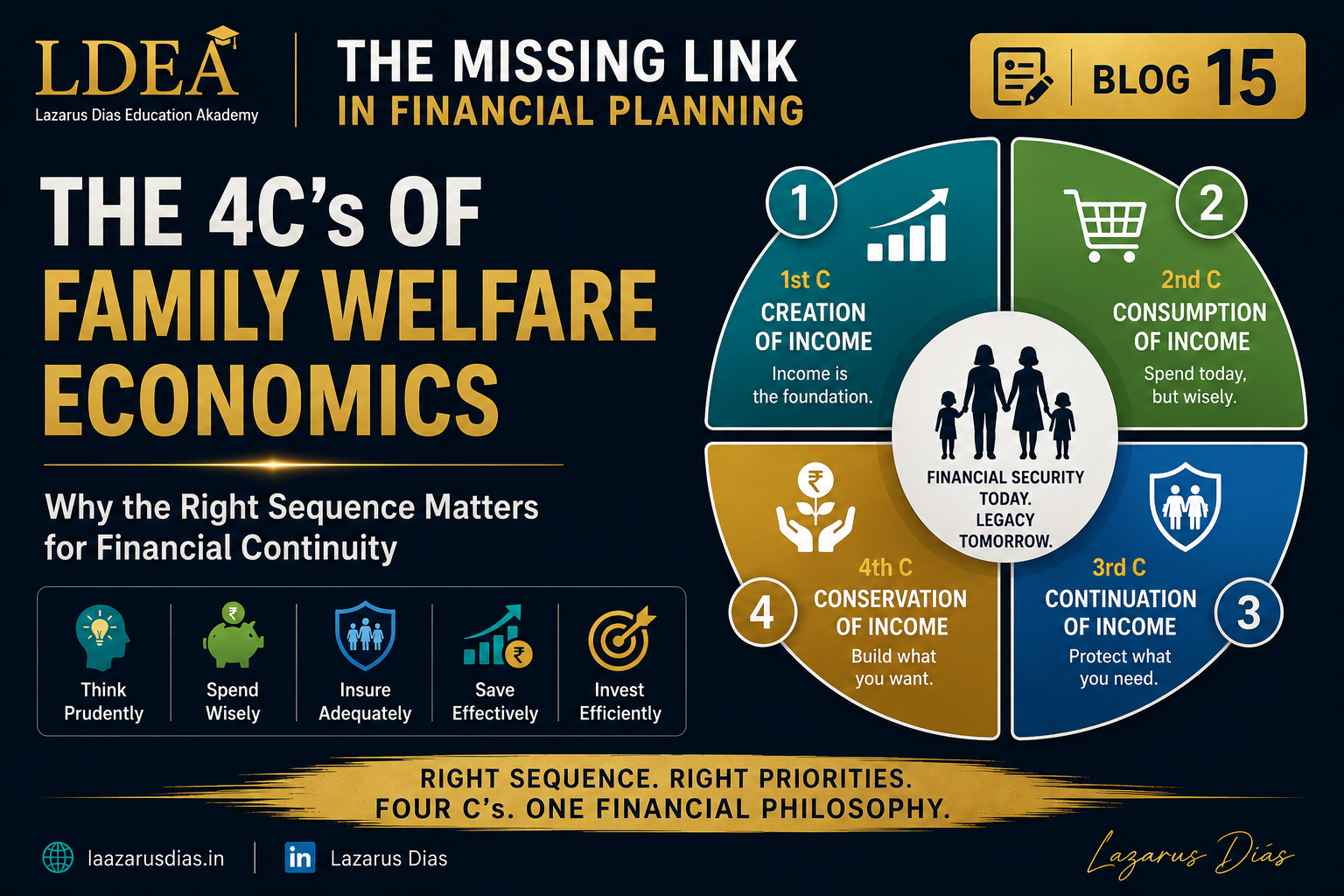
The 4C’s of Family Welfare Economics
Why the Right Sequence Matters for Financial Continuity
Throughout this series, we have explored why financial plans often fail despite good investments and sound advice.
We introduced the 2–3–2 Framework—2 Gaps, 3 Layers and 2 Risks. We explored the Present Gap and Future Gap, Need Goals and Want Goals, and the three layers of Protection, Stability and Growth. We then examined Investment Volatility Risk and Behavioural Discipline Risk.
In the previous article, I introduced the 4C’s Philosophy as a way to bring behaviour and financial planning together.
In this article, we go deeper into each of the four C’s and understand why the sequence matters.
Why Do We Need the 4C’s?
We spend years being educated to become employable, build careers or start businesses. We learn economics, finance and business, but very few of us are taught how to manage our own family finances once we begin earning.
When the first salary arrives, there is usually no framework telling us:
- How much should we spend?
- How much should we save?
- What should we protect?
- Which goals should come first?
- When should we invest for wealth creation?
Instead, we often learn by watching others.
We compare our homes, cars, holidays and lifestyles with friends and relatives and gradually begin to copy them. Social comparison can turn income into lifestyle inflation without any deliberate financial plan.
The result is often a short-term approach to money.

The 4C’s of Family Welfare Economics provides a simple philosophy to help families think more prudently about money.
It encourages us to:
Think Prudently.
Spend Wisely.
Insure Adequately.
Save Effectively.
Invest Efficiently.
Money can certainly contribute to happiness and a better quality of life. But unmanaged money can also become a source of stress, debt and financial insecurity.
The objective is not simply to earn more.
It is to manage what we earn so that today’s lifestyle does not compromise tomorrow’s security.
Going Deeper into the 4C’s
The objective of the 4C’s Philosophy is to create wealth, protect created wealth and eventually propagate wealth to the next generation.
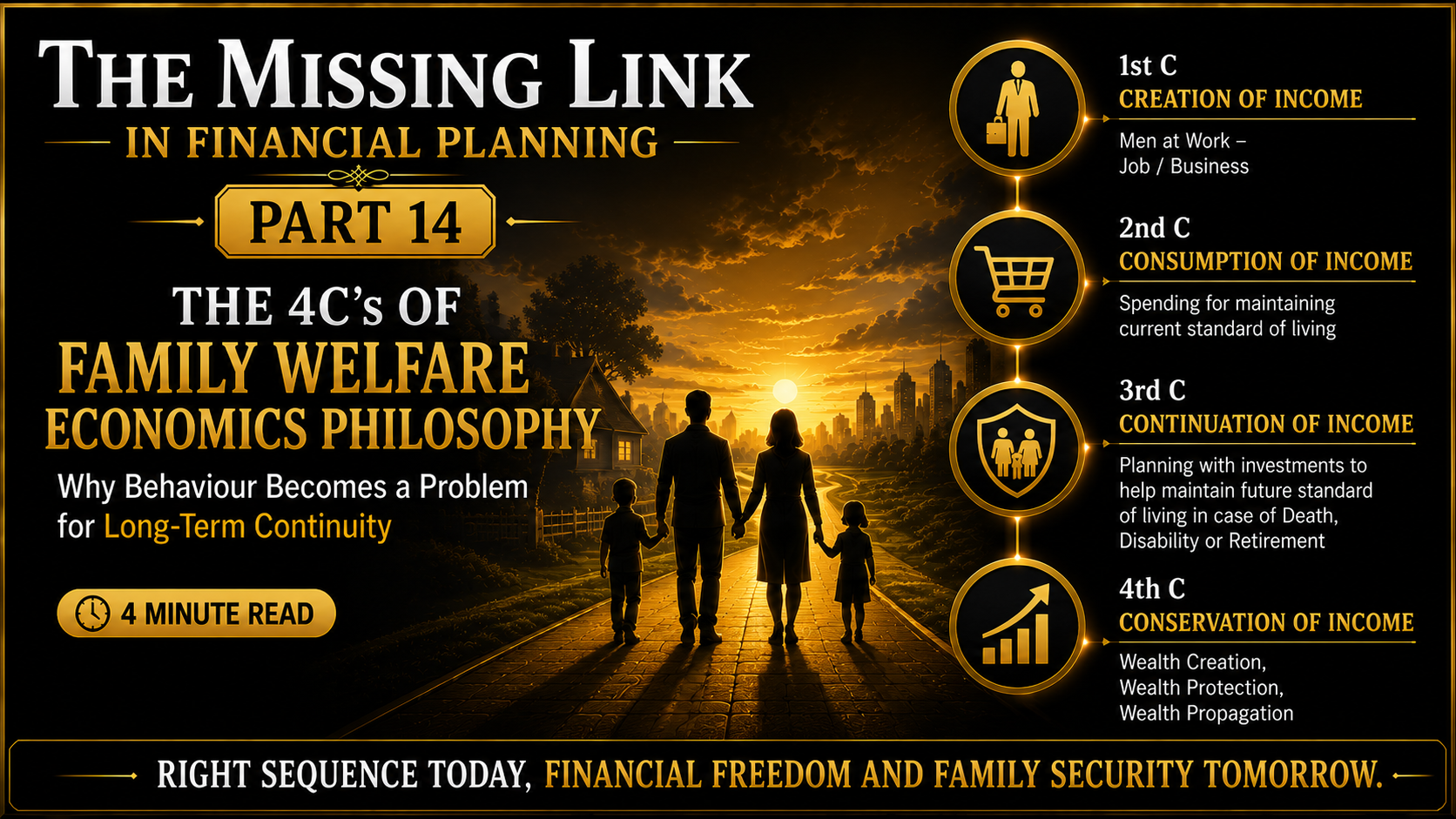
1st C – Creation of Income
Everything begins with income.
The first C refers primarily to active income generated through employment or business.
This income creates the resources from which the family’s lifestyle, protection and future goals can be funded.
Passive income generated from investments belongs to the 3rd C—Continuation of Income, because its purpose is to support financial continuity.
Without a sustainable income stream, there is little scope for meaningful financial planning.
2nd C – Consumption of Income
Consumption is not the enemy.
Uncontrolled consumption is.
The second C represents the money we use to maintain our current standard of living.
The important question is:
How much can I spend today without compromising my financial security tomorrow?
As income increases, lifestyle can certainly improve. But lifestyle inflation must remain within a level that can be sustained over the long term.
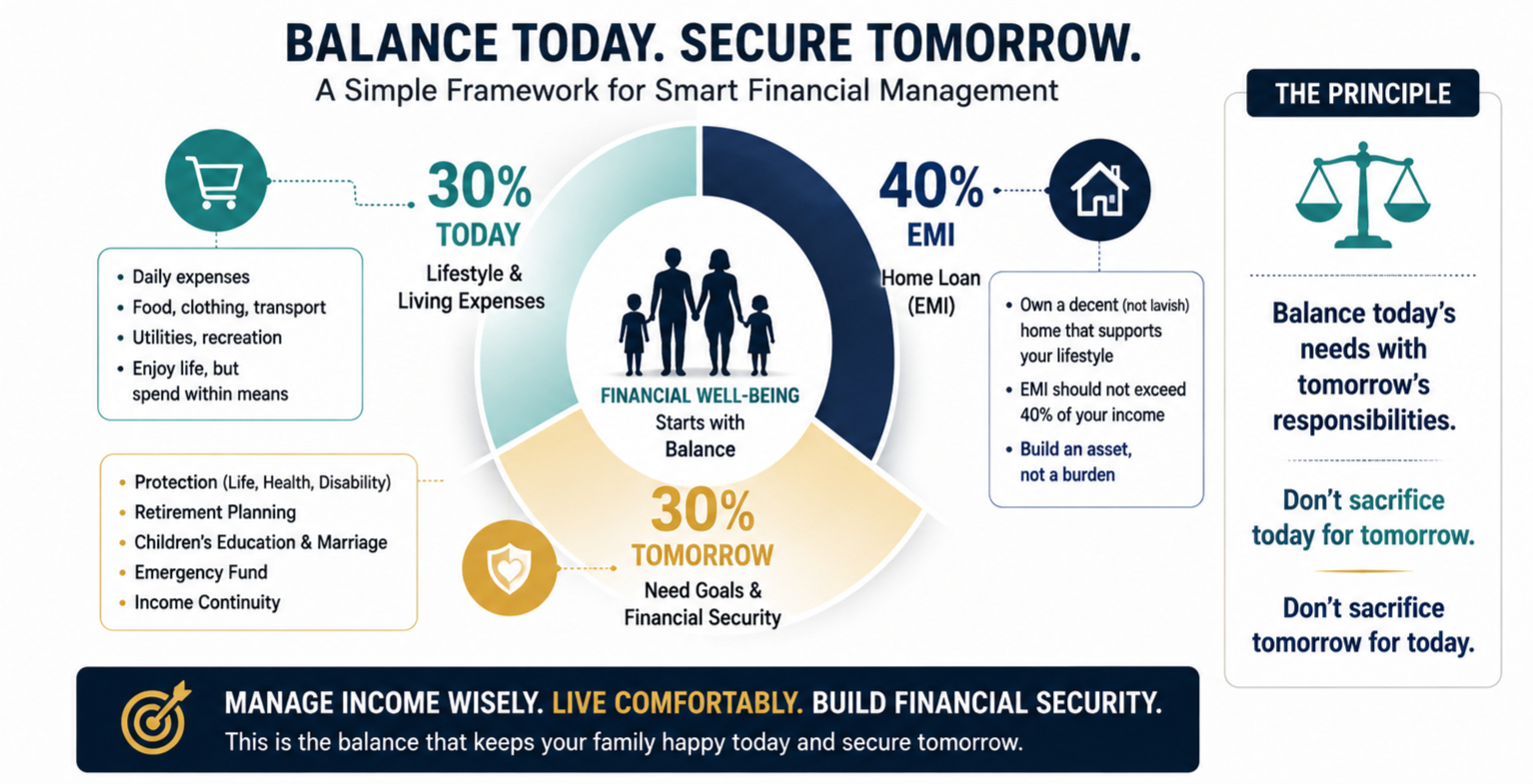
A useful discipline is to allocate approximately 30% of income towards current living expenses, while ensuring that future financial commitments are funded before Want Goals begin consuming the surplus.
The objective is not to live poorly today for the sake of tomorrow.
It is to balance today’s happiness with tomorrow’s security.
3rd C – Continuation of Income
This is the most critical C in the philosophy.
The question is:
“What happens to the family’s lifestyle if today’s income stops?”
Continuation of Income addresses the family’s Protection and Need Goals through appropriate liquid assets.
These may include:
- Protection against premature death
- Disability
- Retirement
- Children’s education
- Children’s marriage
- Emergency reserves
- Temporary loss of employment or business income
The first priority is to address the Present Gap and ensure that important Need Goals are not compromised.
This is why I believe fixed-time Need Goals should be supported primarily through liquid financial assets, rather than depending on property or other assets that may take time to sell.
The family should not be forced to sell a valuable asset at the wrong time simply because cash is needed immediately.
The third C is therefore about financial continuity.
4th C – Conservation of Income
Once Need Goals and financial continuity are adequately addressed, the family can focus on the fourth C—Conservation of Income.
This is where wealth creation, wealth protection and wealth propagation become the focus.
With the family’s essential financial needs secured, a greater portion of the portfolio can be directed towards long-term wealth creation and Want Goals.
This may include assets such as:
- Shares and equity investments
- Property
- Gold
- Collectibles and alternative assets
- Paintings and artwork
- Antiques
- Rare coins
- Stamps
- Vintage jewellery
- Memorabilia
The distinction is important:
3rd C protects what the family needs.
4th C builds what the family wants.
The fourth C should never compromise the third C.
The Story of Vincent
Vincent was a CXO-level executive at Monsanto whom I met in 1999.
When I presented the 4C’s concept to him, he invited me to his home. What I saw surprised me.
He was earning around ₹20 lakh a year, but his annual expenses were only about ₹3 lakh.
Vincent was extremely concerned about his future. He had accumulated a substantial surplus but was sacrificing almost everything in the present to prepare for tomorrow.
It was an extreme example of the opposite problem.
I explained that financial planning should not require him to live an unnecessarily restricted life when he could comfortably afford a better lifestyle without compromising his future.
Together with his wife, we planned a lifestyle expenditure of around ₹6 lakh a year—still well within his means while leaving substantial resources for future goals.
The lesson was important:
Financial planning is not about sacrificing today for tomorrow.
It is about creating a balance between the two.
The Sequence Is the Philosophy
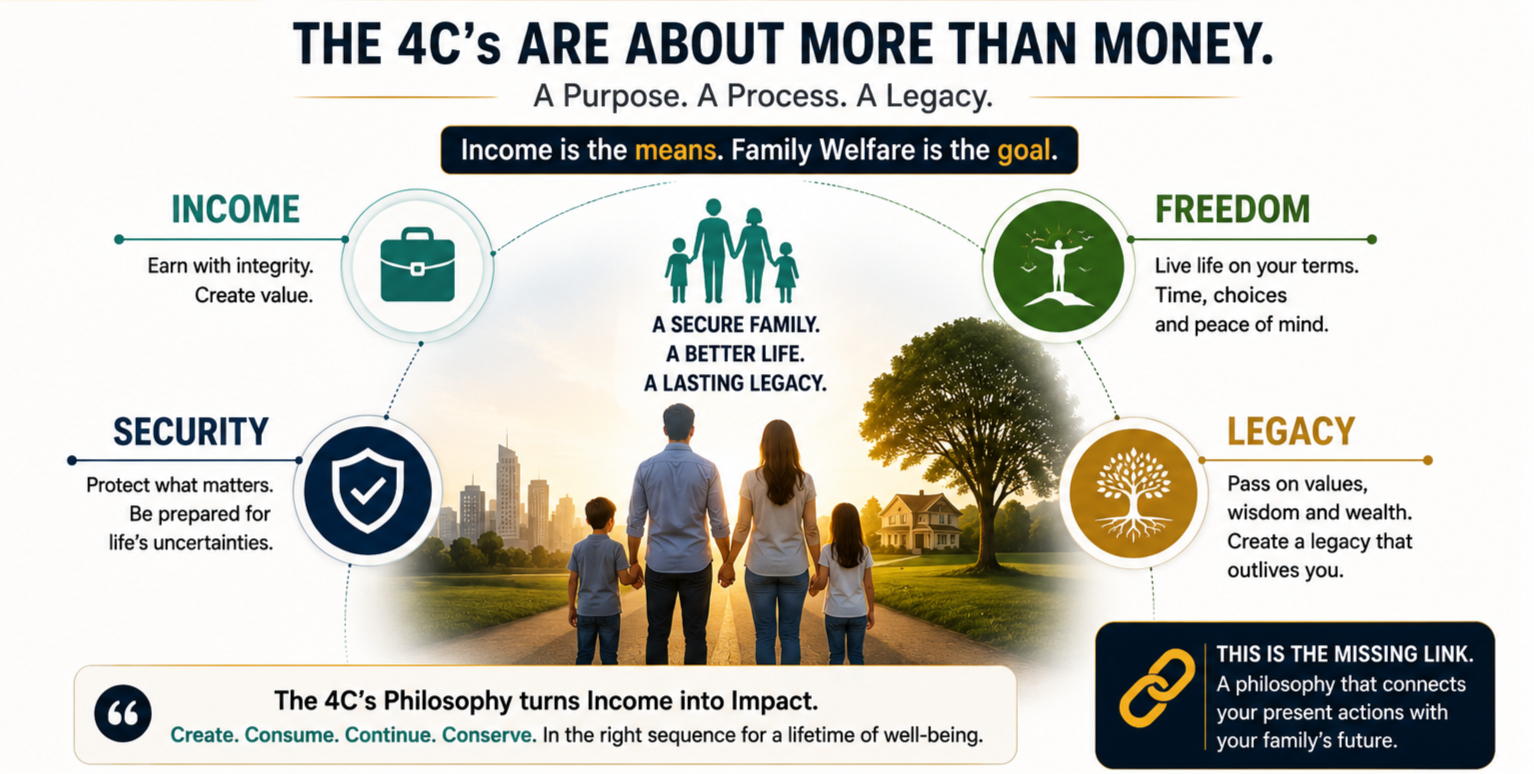
The 4C’s must follow a logical sequence:
1st – Create Income
2nd – Consume Income
3rd – Continue Income
4th – Conserve Income
It is not enough to do all four C’s.
They must be done in the right sequence.
When the sequence is respected, today’s income can support today’s lifestyle while simultaneously protecting tomorrow’s financial security and creating the foundation for future wealth.
That is the real purpose of the 4C’s of Family Welfare Economics.
In the next article, we will explore what happens when families follow the 4C’s in the wrong sequence—and how these different behaviours can lead to very different financial outcomes.
To read my next blog please click on the link below But if you have just read this blog then you can go below aand click on link to Blog 1 to read all blogs before this Blog
If you have come to thiis Blog for the 1st time then i would request you to click on the Link below and read all Blogs from Blog 1 to have a very clear understanding of the subject matter.