
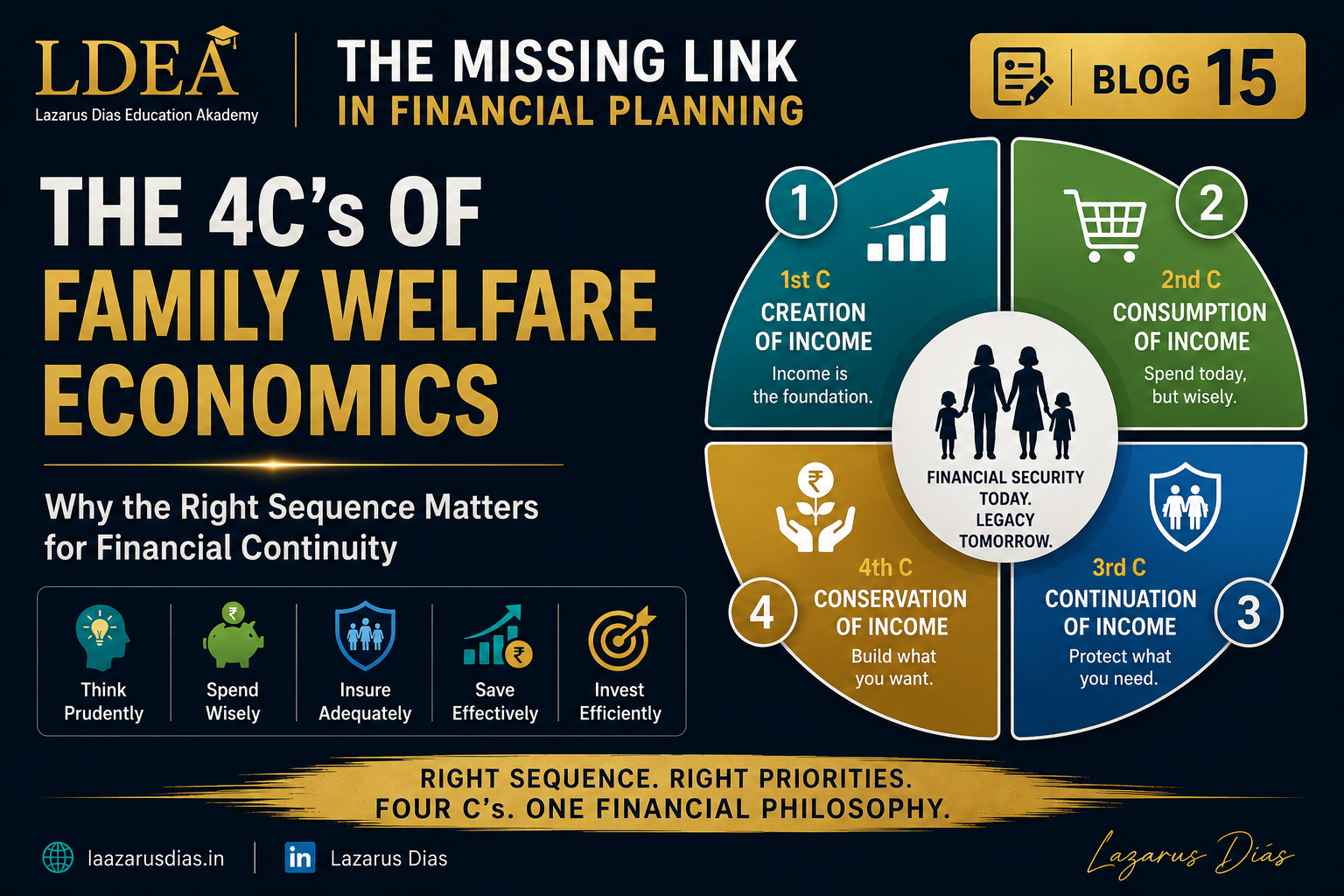
THE MISSING LINK IN FINANCIAL PLANNING – Part 15
August 26, 2026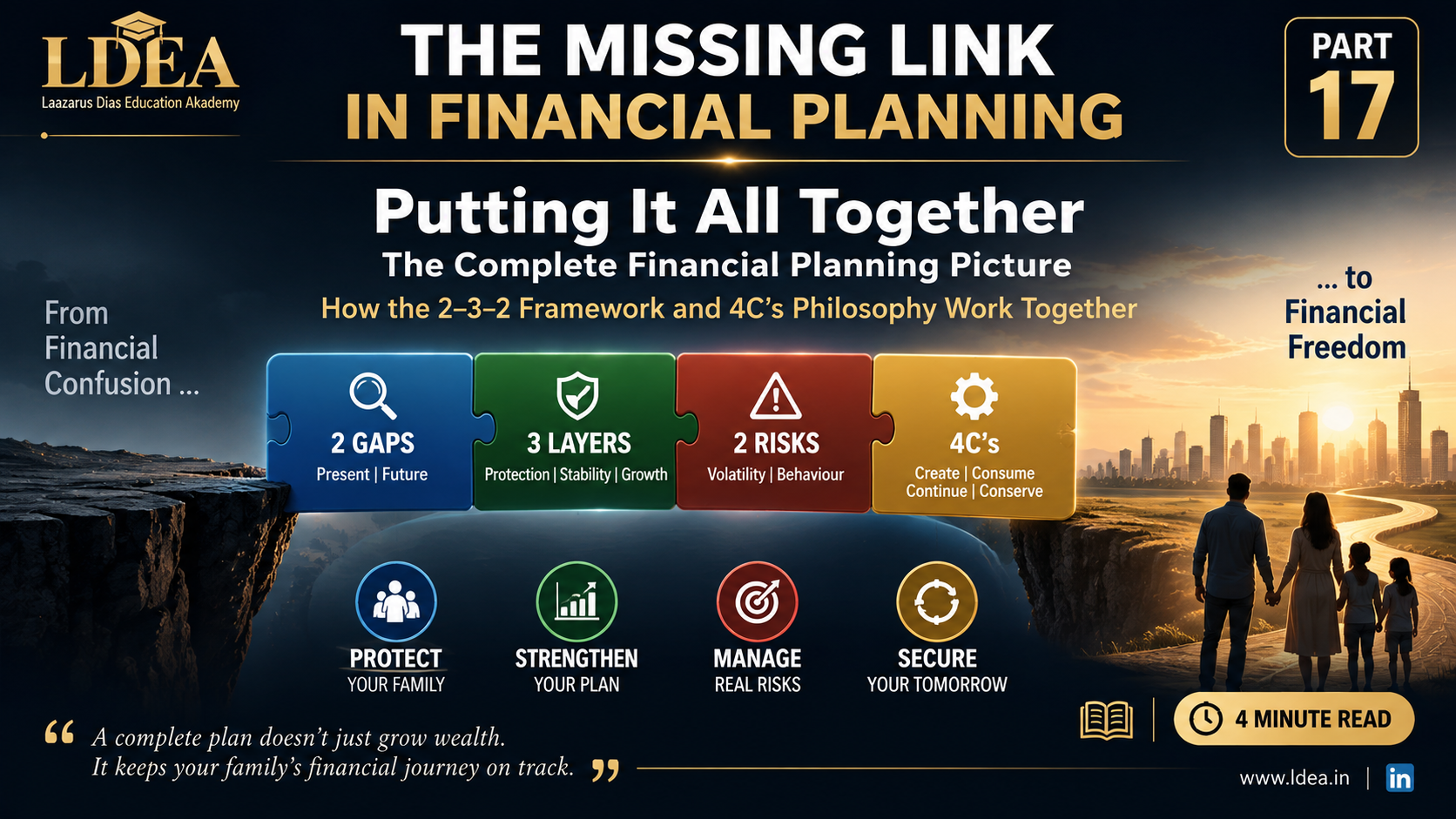
MISSING LINK IN FINANCIAL PLANNING – Part 17
September 9, 2026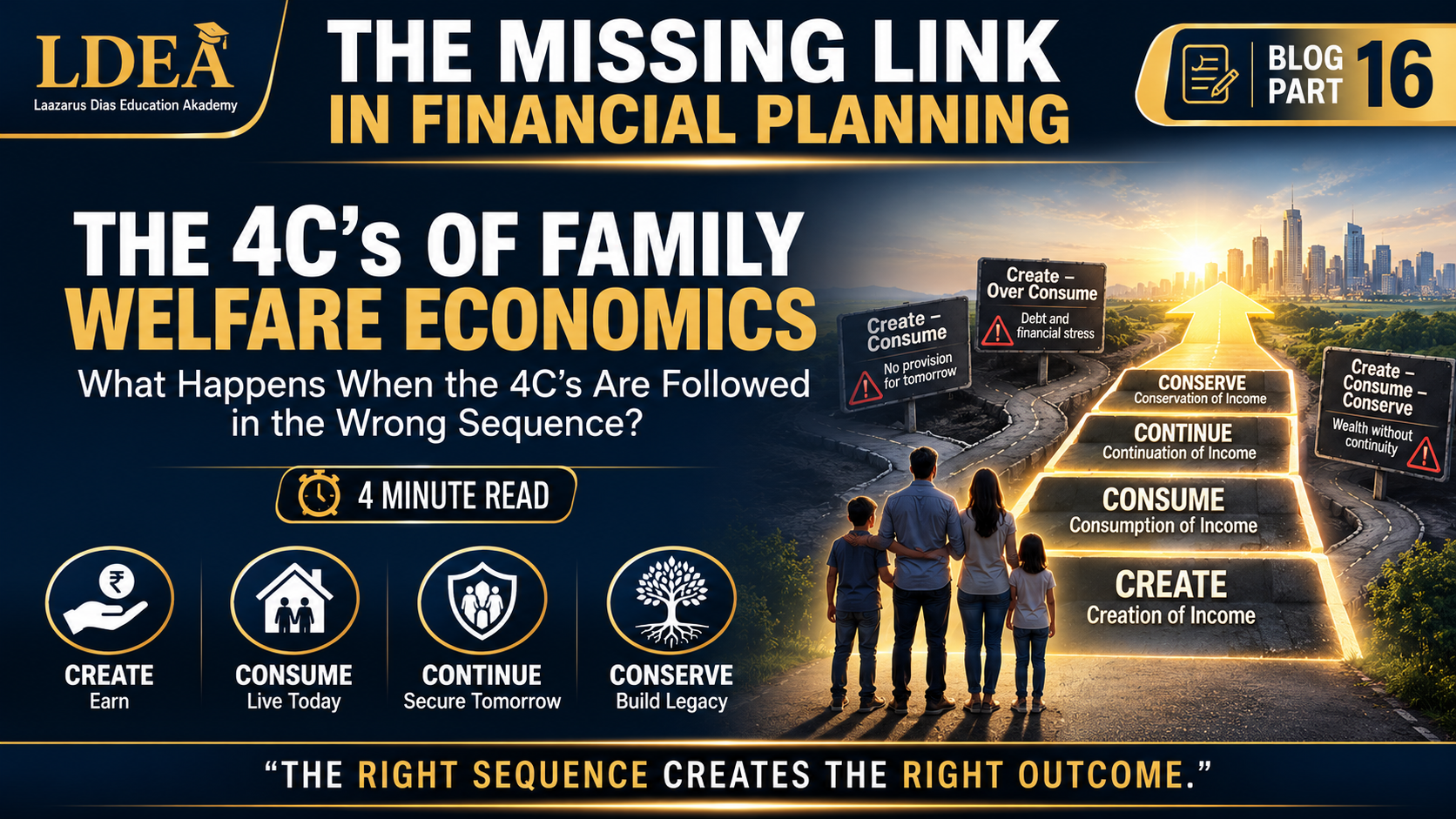
The 4C’s of Family Welfare Economics
What Happens When the 4C’s Are Followed in the Wrong Sequence?
Throughout this series, we have explored why financial plans often fail despite good investments and sound advice.
We introduced the 2–3–2 Framework—2 Gaps, 3 Layers and 2 Risks. We explored the Present Gap and Future Gap, Need Goals and Want Goals, and the three layers of Protection, Stability and Growth. We then examined Investment Volatility Risk and Behavioural Discipline Risk.
In the previous two articles, I introduced the 4C’s Philosophy and explained why the sequence matters.
In this article, we look at what happens when families follow the 4C’s in the wrong sequence.
The Right Sequence
The right sequence is:
Create → Consume → Continue → Conserve
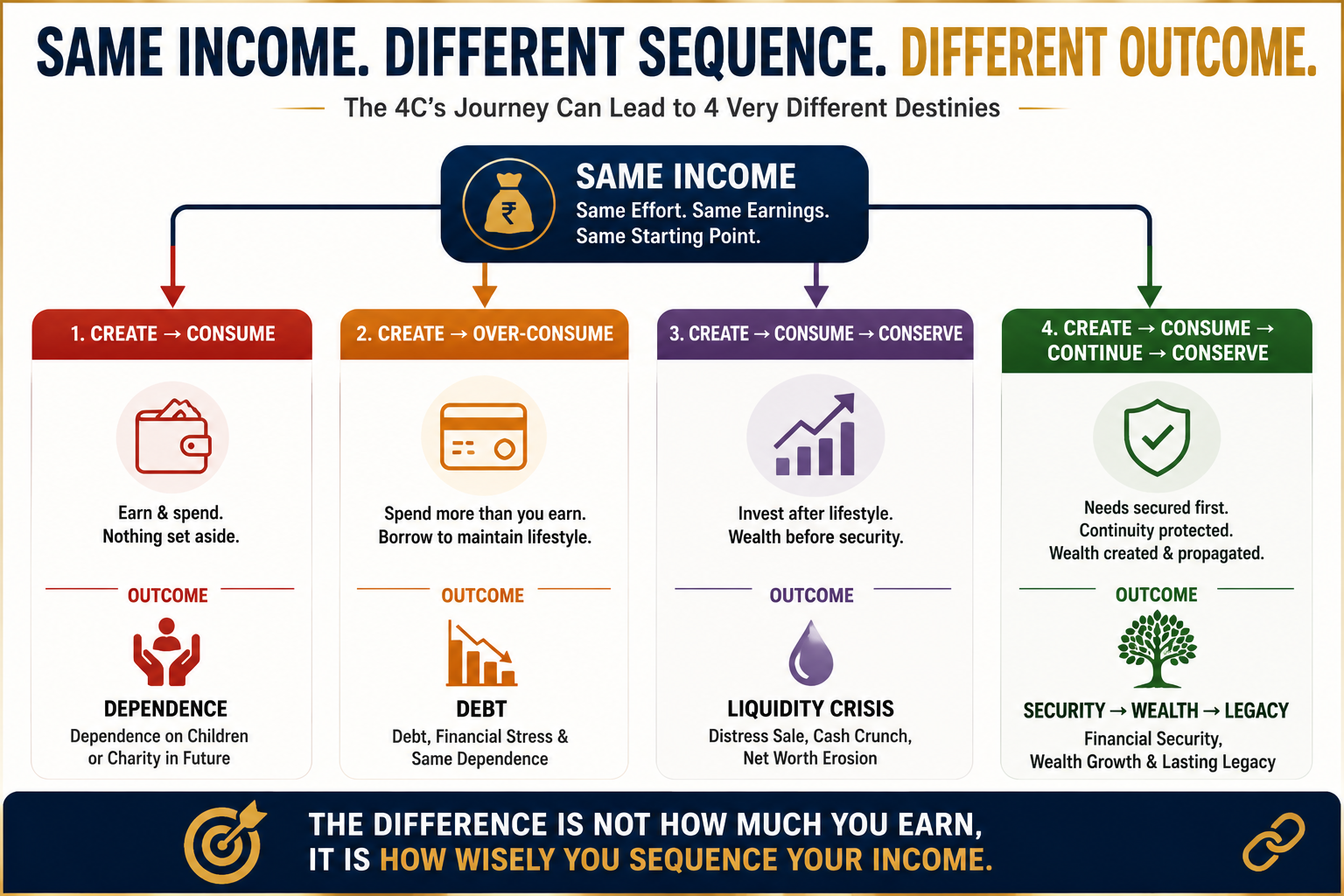
But there are three common ways families can break this sequence:
- Create → Consume
- Create → Over-Consume
- Create → Consume → Conserve
The important lesson is that the same income can produce very different outcomes depending on the sequence in which it is used.
In life, we have choices. But every choice has a consequence.
Understanding those consequences before making financial decisions can make the difference between financial security and financial dependence.
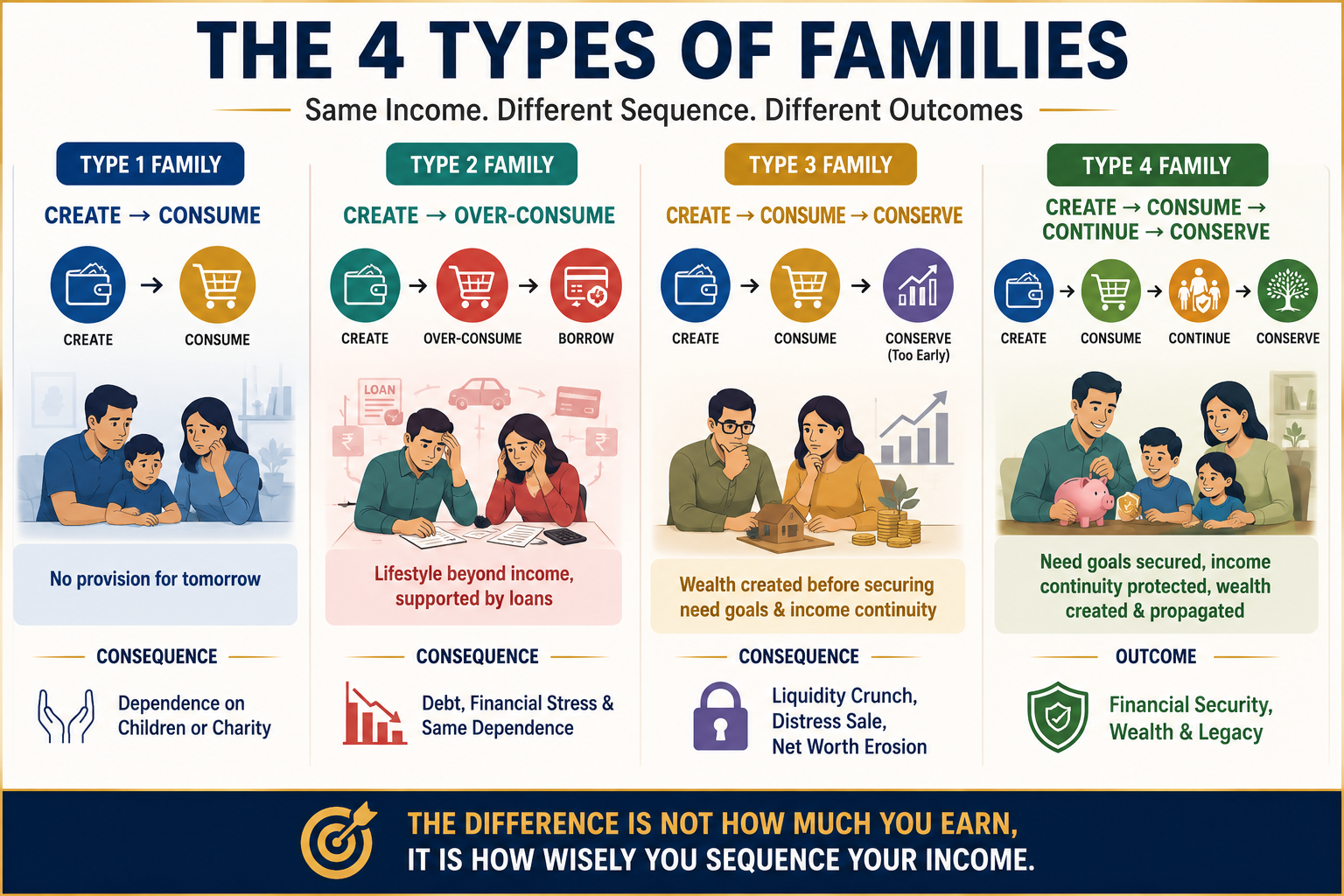
Type 1 Family – Create → Consume
These families earn and spend what they earn, leaving little or nothing for the future.
For some, this is unavoidable. Their income is barely sufficient to meet basic needs. For others, income is sufficient, but they choose to match their lifestyle to their earnings without setting aside resources for tomorrow.
They may be living within their means, but they have no financial buffer.
As long as the breadwinner continues to earn, life may continue normally. But an unfortunate death, disability or retirement can immediately expose the vulnerability.
In the future, the consequences can be severe.
Without adequate planning, the family may ultimately depend on children or charity.
This creates a very different set of 4C’s:
Create → Consume → Children → Charity
Children may willingly support their parents, but their own financial responsibilities may make it difficult. More importantly, financial dependence can take away a person’s choice, dignity and independence.
Type 2 Family – Create → Over-Consume
These families go beyond living within their means.
They consume more than they earn and use loans to maintain a lifestyle they cannot sustainably afford.
A bigger house, expensive cars, luxury holidays and constant lifestyle upgrades can gradually turn income into financial commitments.
The danger tremendously increases when economic conditions change.
A rise in interest rates, inflation, loss of employment or business income can quickly create a liquidity crisis.
Like Type 1 families, they may ultimately face serious difficulties in the event of death, disability or retirement.
The difference is that Type 1 has too little surplus, while Type 2 consumes too much.
Both can eventually arrive at the same destination:
Dependence on children or charity.
Type 3 Family – Create → Consume → Conserve
This is perhaps the most deceptive type.
These families earn well, maintain their lifestyle and have a surplus.
They also invest.
The problem is what they invest in and when.
Instead of first securing their Need Goals and Continuation of Income, they move directly into wealth-creating or non-liquid assets such as property and shares.
In other words:
They conserve before they continue.
This means Want Goals may be funded before Need Goals.
The consequences can be serious.
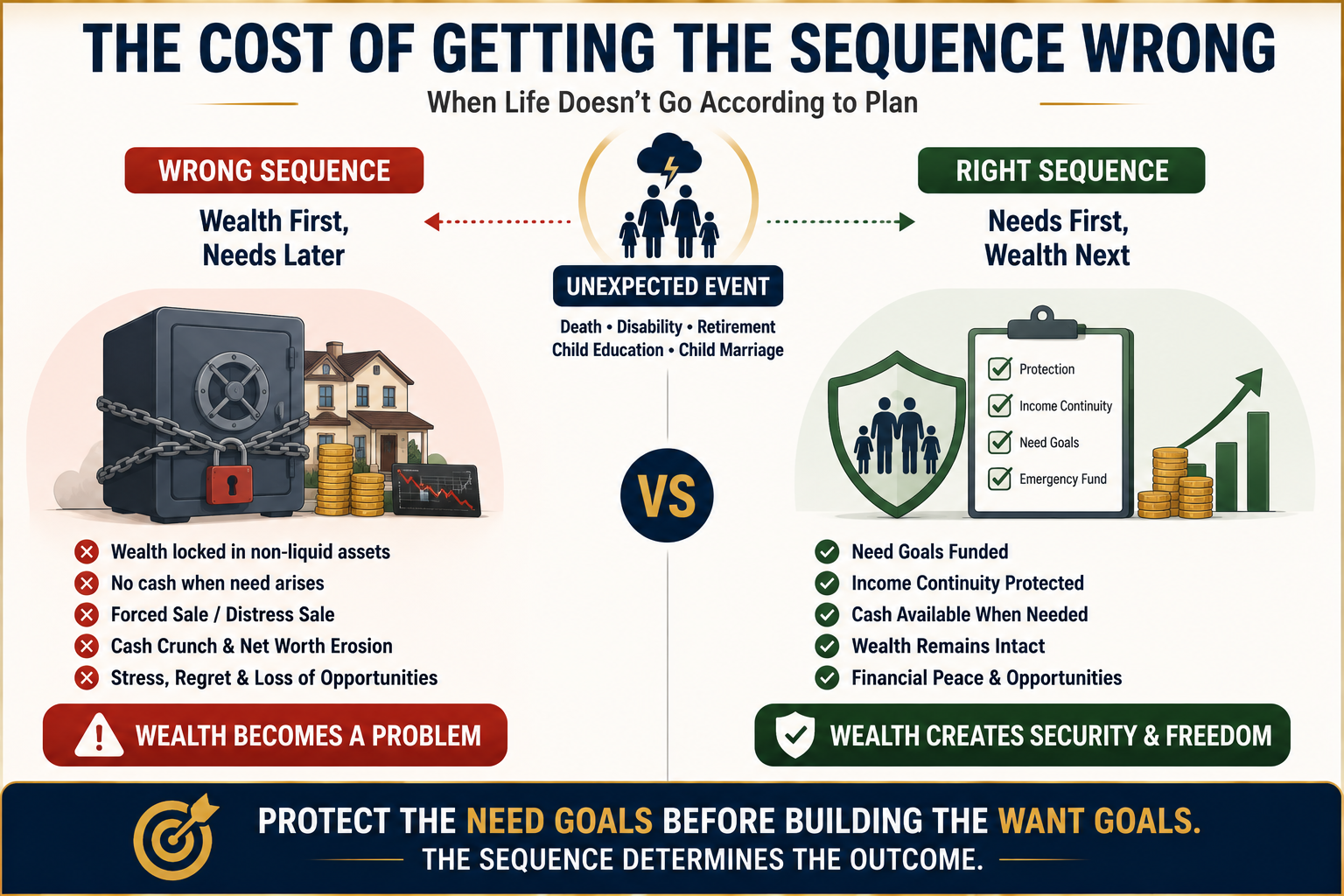
Death, disability, retirement, children’s education or marriage can create a sudden need for cash. If the required money is not available through liquid investments, the family may be forced to sell property or investments.
And what happens if the market is falling exactly when the money is needed?
They may have to sell at a distressed price.
The family may have substantial net worth, but insufficient liquidity.
That is the fundamental mistake:
Wealth without liquidity can become a financial problem when you need money urgently.
Stories of Wealth That Disappeared
We have all heard stories of people who earned or received enormous amounts of money but eventually lost it.
Mike Tyson, one of boxing’s greatest champions, earned hundreds of millions of dollars during his career but eventually declared bankruptcy.
In India, Sushil Kumar, who won ₹5 crore on Kaun Banega Crorepati, became an overnight millionaire after previously earning a modest salary. His financial journey later changed dramatically, and he eventually returned to a much simpler life as a government school teacher.
Actress Vimi, who rose to fame after Hamraaz, also experienced the dramatic reversal of fortune, reportedly spending her final years in severe financial difficulty.
These stories are different, but they carry the same lesson:
Earning or accumulating wealth is not enough. The sequence in which wealth is managed matters.
My Own Experience
My own financial journey has reinforced this belief.
Around ten years ago, I consciously rerouted my financial journey and began applying the principles of the 4C’s more deliberately.
The difference compared with the previous three decades has been phenomenal.
It reinforced something I now strongly believe:
It is never too late to correct the sequence.
Starting late may make the journey harder, but changing the way we manage our income can still make a meaningful difference.
The Benefits of the Right Sequence
The right sequence is:
Create → Consume → Continue → Conserve
A useful discipline is to keep approximately 30% of income for current consumption and allocate another 30% towards Continuation and Need Goals, subject to the family’s circumstances.
This creates a deliberate balance between today and tomorrow.
When Need Goals are adequately funded first:
- The family has resources when important goals arise.
- Protection is in place if income suddenly stops.
- Retirement can be planned without compromising lifestyle.
- Children’s major Need Goals can be funded without disturbing long-term wealth.
- Property and other wealth-creating assets need not be sold under pressure.
- Wealth can eventually be preserved and propagated to the next generation.
I have seen this principle particularly well demonstrated in families that preserve investments across generations. Some Parsi families, for example, have held shares across two or three generations, allowing wealth to compound and multiply over decades.
The key is that Want Goals do not have to be sacrificed.
They simply come after Need Goals have been secured.
That is the power of the right sequence.
The Real Difference
Four families may have similar incomes.
One may spend everything.
Another may borrow to spend even more.
A third may accumulate substantial wealth but leave its Need Goals unfunded.
The fourth follows the sequence:
Create → Consume → Continue → Conserve.
Their financial outcomes can be completely different.
Financial success is not determined only by how much you earn.
It is also determined by what you do with your income—and when you do it.
In the next article, we will bring the entire 2–3–2 Framework together and see how the 2 Gaps, 3 Layers, 2 Risks and the 4C’s Philosophy connect to create a complete approach to financial continuity.
If you have reached this blog for the 1st time, I would request you to go to Blog 1 and read all the blogs to get a correct perspective of the Topic and the blog is below the link to blog 17