
THE MISSING LINK IN FINANCIAL PLANNING – Part 13
August 12, 2026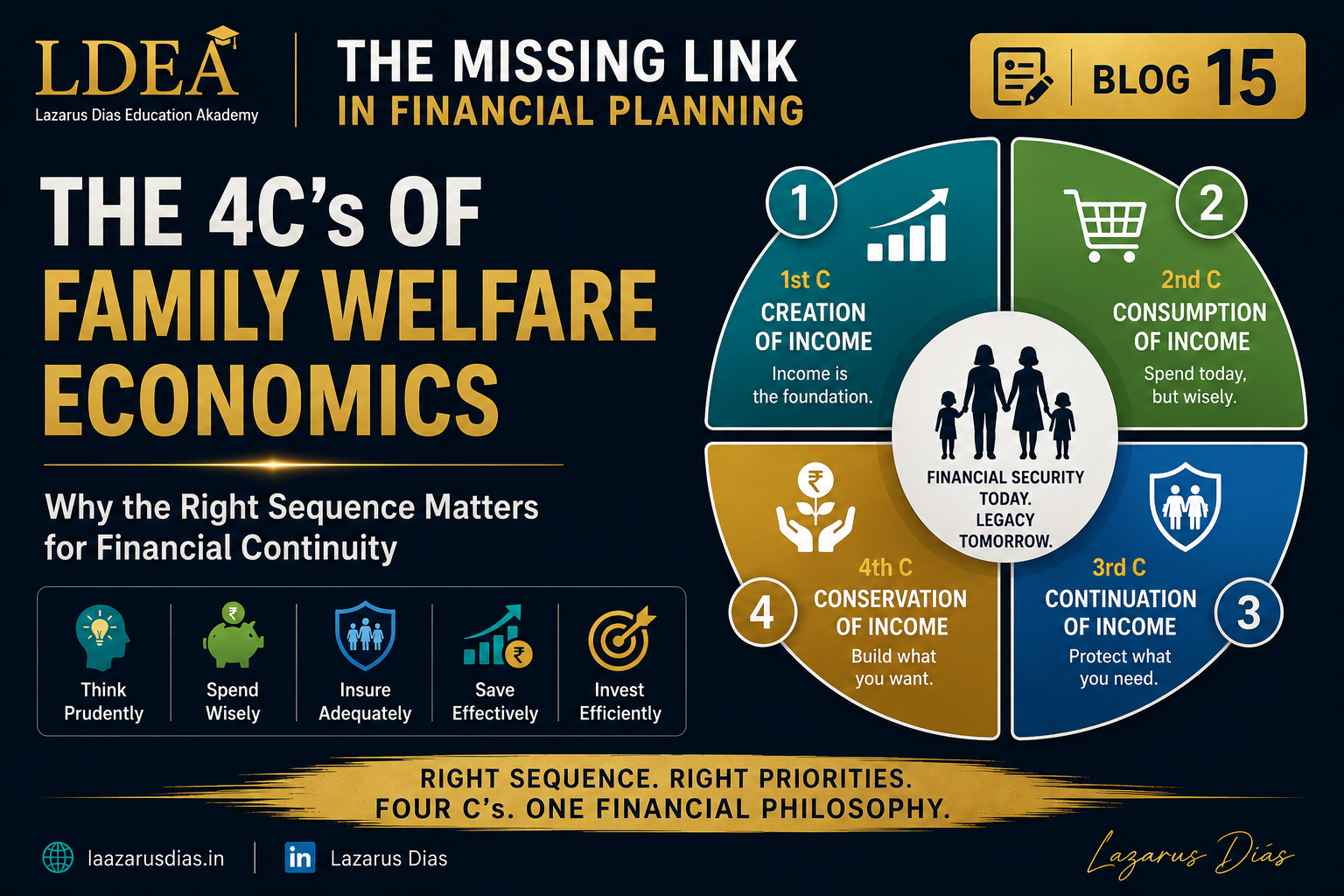
THE MISSING LINK IN FINANCIAL PLANNING – Part 15
August 26, 2026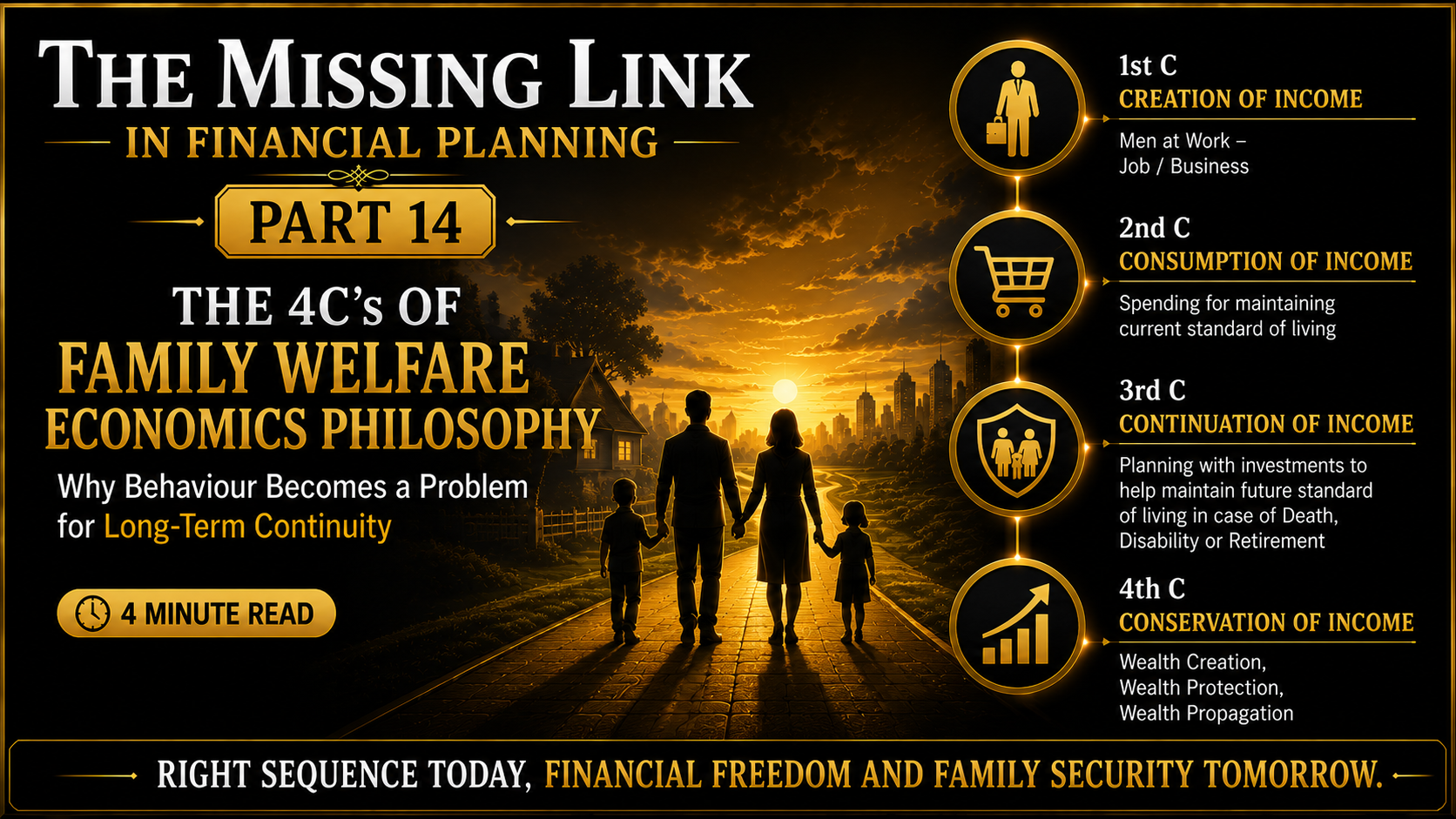
The 4C’s of Family Welfare Economics
Why Behaviour Becomes a Problem for Long-Term Continuity
Throughout this series, we have explored why financial plans often fail despite good investments and sound advice.
We introduced the 2–3–2 Framework—2 Gaps, 3 Layers and 2 Risks. We explored the Present Gap and Future Gap, Need Goals and Want Goals, and the three layers of Protection, Stability and Growth. We then examined Investment Volatility Risk and Behavioural Discipline Risk.
In the previous article, we saw that the biggest threat to a financial plan may not be the market, but the behaviour of the investor.
This brings us to the next question:
How can a family structure its financial life so that behaviour naturally supports long-term continuity?
This is where I introduce the 4C’s of Family Welfare Economics.
The 4C’s Philosophy
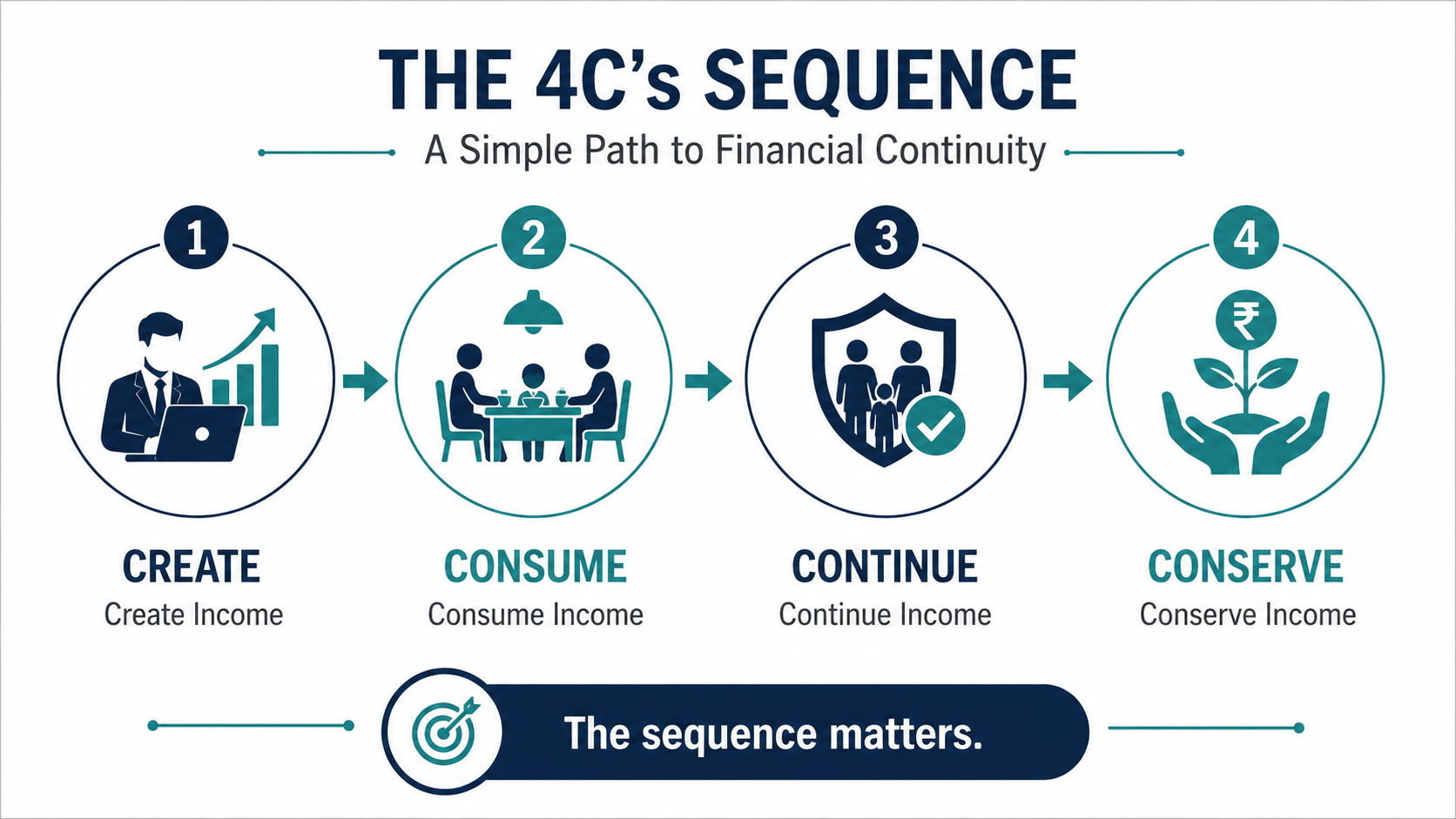
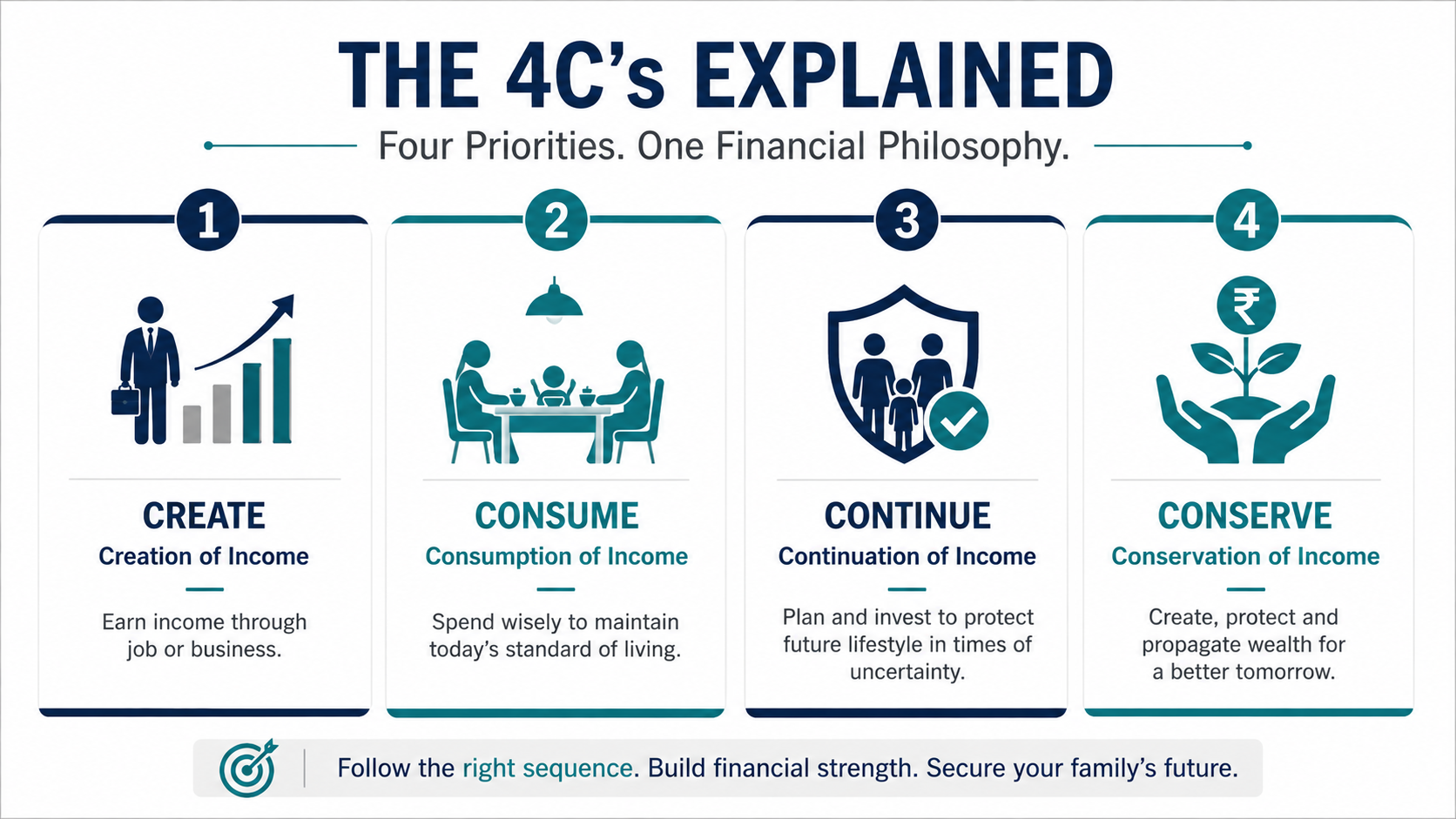
The 4C’s is a philosophy for managing family income through four sequential priorities:
| 1st C | 2nd C | 3rd C | 4th C |
| Creation of Income | Consumption of Income | Continuation of Income | Conservation of Income |
| Earn through job or business | Maintain today’s lifestyle | Protect tomorrow’s lifestyle | Create, protect and propagate wealth |
The sequence is important.
First create income.
Then consume it.
Then ensure its continuation.
Only then focus on conserving and propagating wealth.
The philosophy is designed to ensure that today’s consumption does not destroy tomorrow’s financial security.
Ideally, a family should control consumption, create a disciplined saving habit, and first address its Need Goals before committing significant resources to Want Goals.
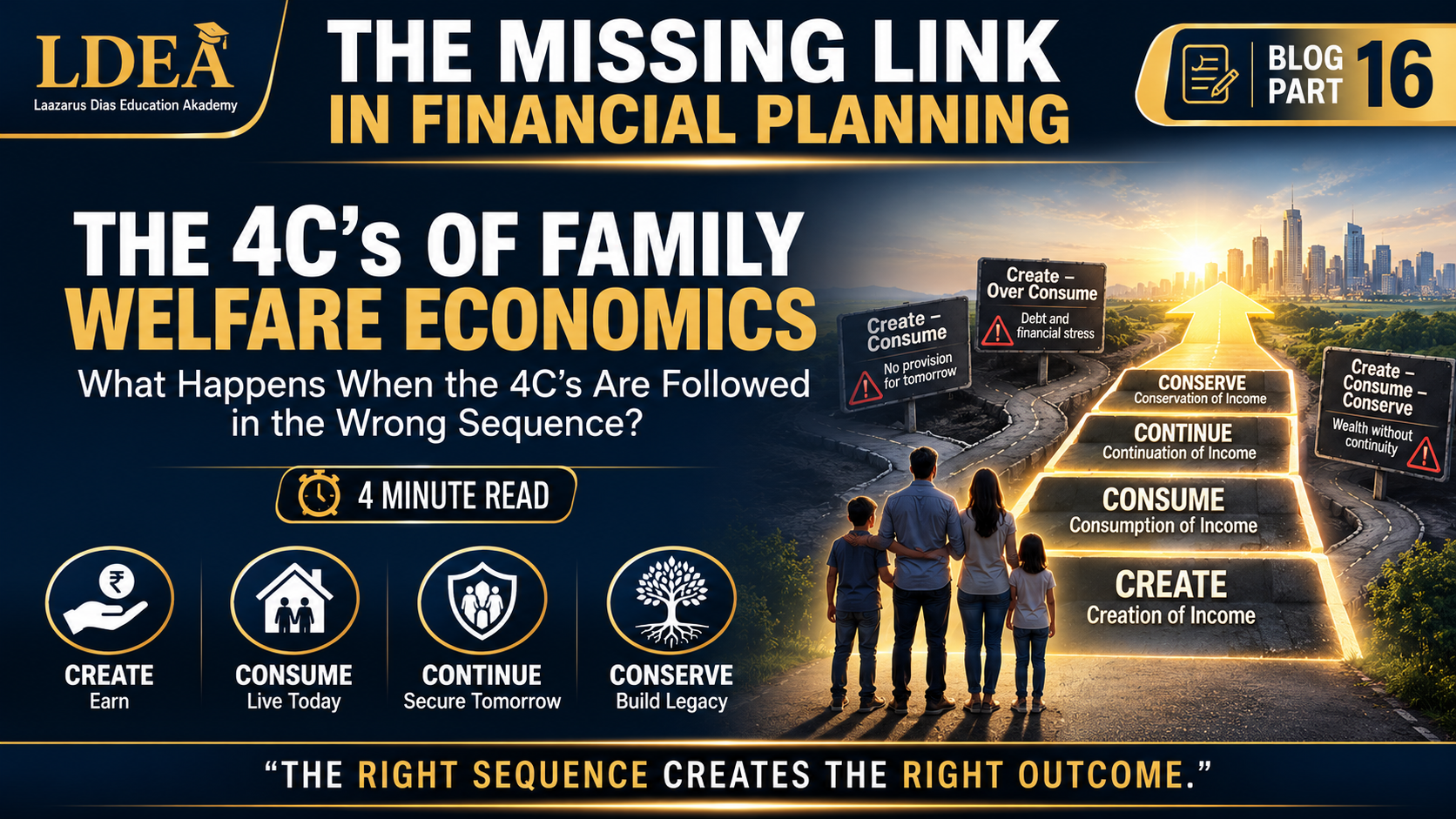
The Four Types of Families
The way a family follows—or breaks—the 4C sequence can produce very different outcomes.
Type 1 – Creation → Consumption
They earn and spend almost everything they earn.
There is little left for protection, retirement or future goals.
As long as income continues, life may appear comfortable. But Death, Disability or Retirement can immediately expose the financial weakness.
Eventually, their financial security may depend on Children or Charity.
Type 2 – Creation → Over-Consumption
These families go one step further. They borrow to maintain a lifestyle beyond their income.
A larger house, expensive purchases, luxury experiences and social comparison gradually increase their financial commitments.
They may appear prosperous, but rising interest rates, inflation, loss of income or retirement can expose the underlying vulnerability.
Their problem is not inadequate income alone.
It is uncontrolled consumption.
Type 3 – Creation → Consumption → Conservation
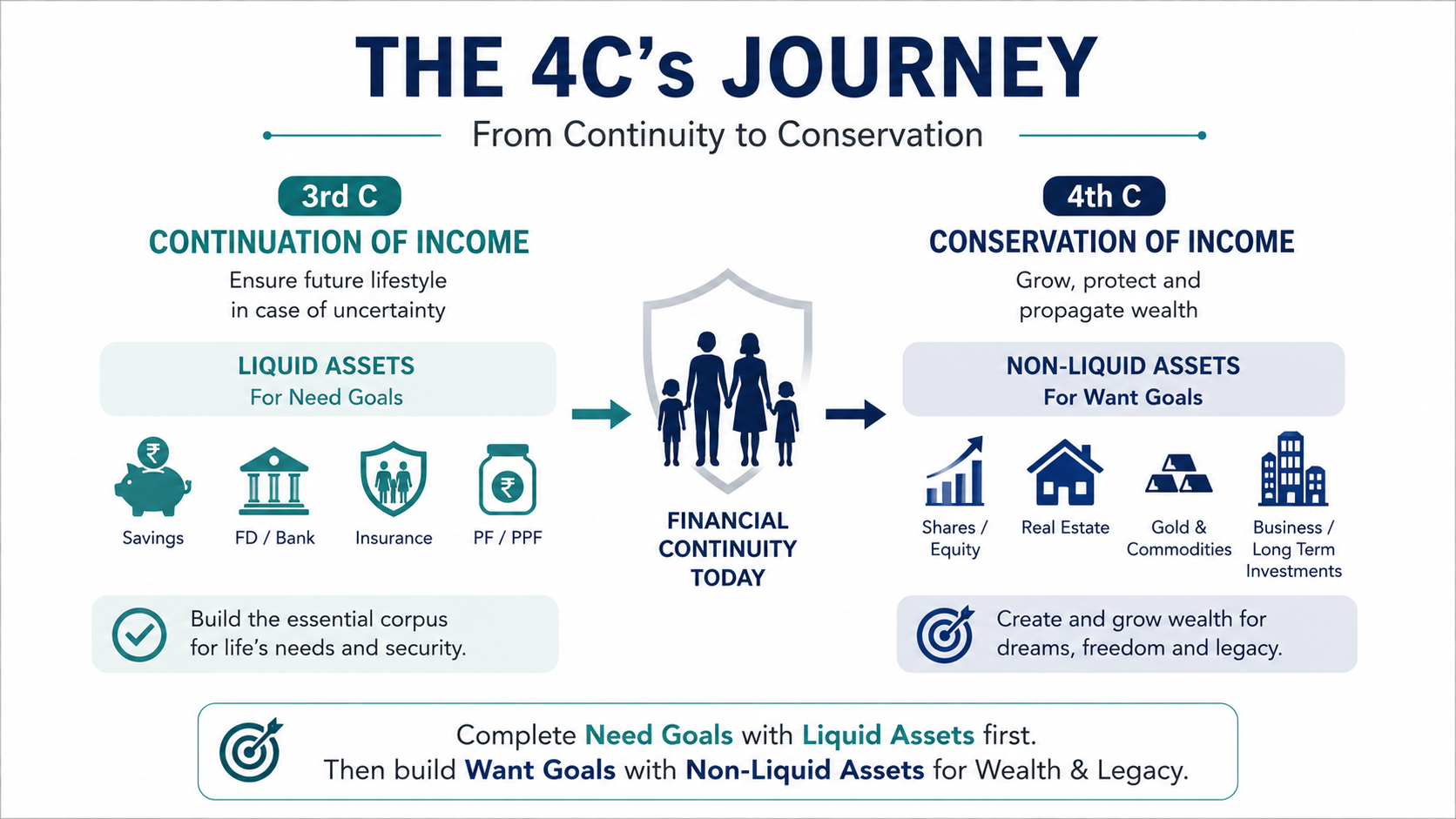
These families do save and accumulate wealth, but often move directly into long-term, non-liquid assets such as property or shares without first completing their Need Goals through appropriate liquid investments.
On paper, they may be wealthy.
In reality, they may face a liquidity crisis when money is urgently required.
Selling property or investments under pressure can result in a distress sale and may prevent the family from preserving and eventually propagating its wealth.
Type 4 – Creation → Consumption → Continuation → Conservation
This is the sequence that supports long-term family welfare.
The family first creates income, manages consumption, protects the continuation of that income through appropriate planning, and only then focuses on conserving and propagating wealth.
This approach addresses the family’s needs today, tomorrow and in the event of an unexpected disruption.
The objective is not simply to become wealthy.
It is to ensure that wealth remains available when the family actually needs it—and can eventually be passed on to the next generation.
The Sahara Lesson: Wealth Is Not the Same as Liquidity
The experience of the Sahara Group provides a powerful illustration of an important financial principle.
At its peak, the group claimed enormous wealth and owned substantial assets, particularly in real estate and other physical investments.
Yet when regulatory and judicial orders required large amounts of money to be returned to investors, the challenge was not simply the value of the assets.
It was liquidity.
Assets can have enormous value and still fail to provide immediate access to cash when the cash is required.
The lesson for a family is equally important:
Being wealthy on paper is not the same as being financially prepared.
A family can own property, shares and other valuable assets and still face financial stress if its money is not available in the right form, at the right time.
That is why the sequence of the 4C’s matters.
The 4C’s Are About Financial Continuity
The purpose of Family Welfare Economics is not to tell families simply to earn more, spend less or invest more.
It is about putting income in the right sequence:
Create → Consume → Continue → Conserve
When this sequence is followed, the family can protect its present lifestyle, fund its Need Goals, manage unexpected events and eventually build wealth for the next generation.
When the sequence is broken, today’s decisions can quietly destroy tomorrow’s financial security.
And that brings us to the heart of the Missing Link:
Financial planning is not complete when a plan is created. It is complete only when the family has a philosophy that helps it follow the plan throughout life.
In the next article, we will explore each of the 4C’s in greater depth and understand how the right sequence can create financial continuity for a family across its entire lifetime.
To go to the next Blog 15, please click on the link below. The Link to Blog 1 is given below that.
If you have reached this atricle 1st Time then please click on the link below to read from Blog 1 so you get complete undersatnding of the Missing Link