
THE MISSING LINK IN FINANCIAL PLANNING – Part 12
August 5, 2026
THE MISSING LINK IN FINANCIAL PLANNING – Part 14
August 19, 2026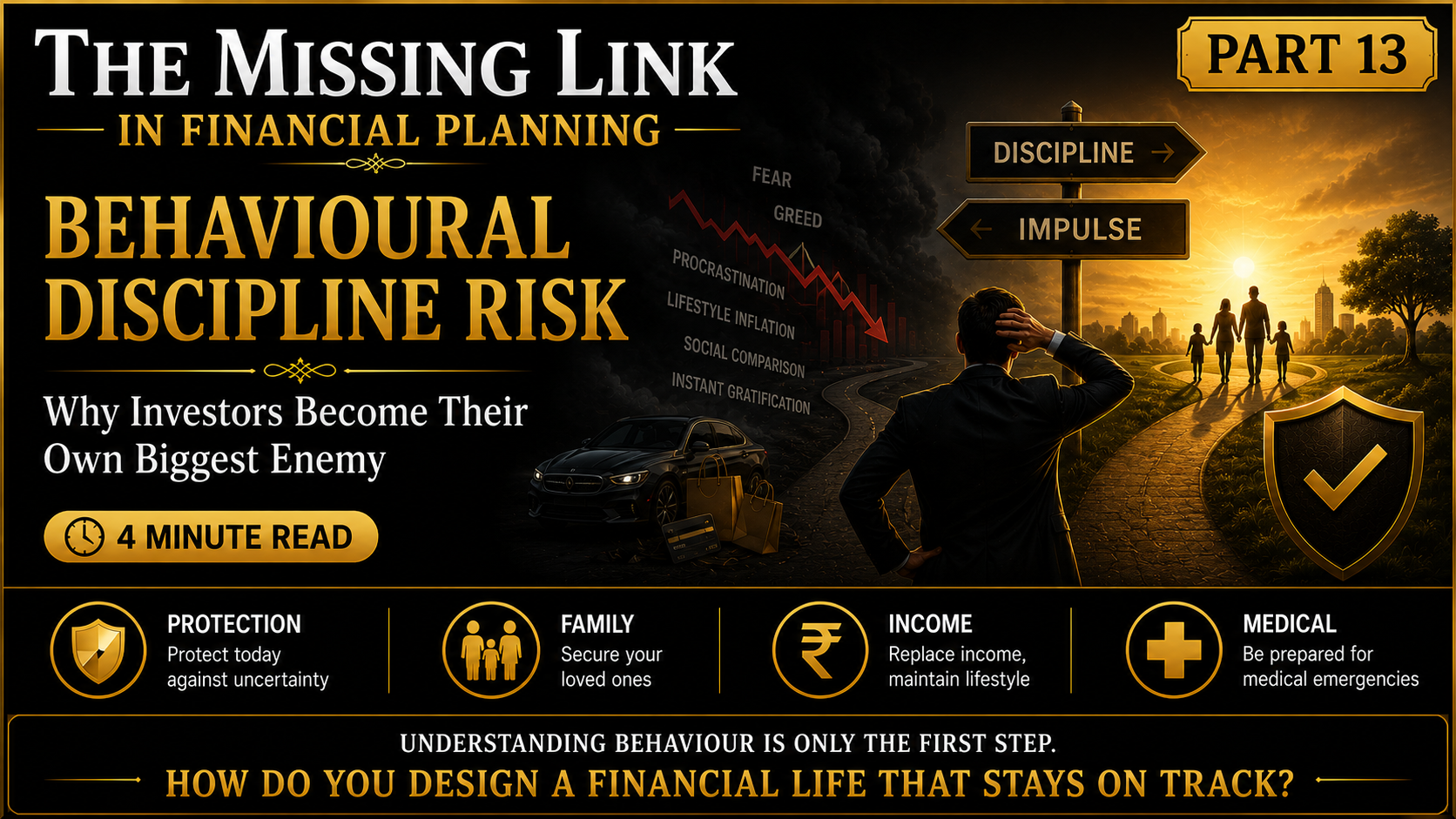
Behavioural Discipline Risk
Why Investors Become Their Own Biggest Enemy
In the earlier parts of this series, I introduced the importance of discipline and continuity in making compounding work, explained the Stability Layer as the missing dimension in financial planning, distinguished between Investment Volatility Risk and Behavioural Discipline Risk, and introduced the 2–3–2 Framework consisting of 2 Gaps, 3 Layers and 2 Risks. We then explored the Present Gap, the Future Gap, the difference between Need Goals and Want Goals, and the three layers—Protection, Stability and Growth. In the previous article, we discussed the first of the two risks—Investment Volatility Risk.
In this article, we focus on the second and, in my opinion, the more important risk—Behavioural Discipline Risk.
What is Behavioural Discipline Risk?
Behavioural Discipline Risk is the risk that investors fail to follow their own financial plan because of emotions, habits and changing priorities.
Most financial plans fail not because they are technically incorrect, but because they are never implemented consistently.
A financial plan may clearly identify the resources required for retirement, children’s education and other Need Goals. The client may even agree with every recommendation. Yet, when real-life decisions arise, emotions often take over.
Want Goals begin to replace Need Goals.
The plan remains inside a file while life moves in a different direction.
Traditional financial planning assumes that once a recommendation is accepted, it will automatically be followed. In reality, this assumption is often the biggest weakness in the planning process.
Behaviour Creates Bigger Losses Than Markets
Markets recover.
Many investors do not.
A temporary fall in the market may reduce the value of investments for a period of time, but markets have historically recovered over the long term.
Behavioural decisions are different.
Stopping SIPs, redeeming long-term investments, postponing planning or diverting funds to non-priority expenses permanently damages the financial plan.
Unlike market volatility, these decisions cannot always be reversed.
The greatest threat to long-term wealth is therefore not the market—but the investor’s own behaviour.
The Behavioural Traps
Several behavioural patterns repeatedly derail financial plans:
- Greed
- Lifestyle inflation
- Social comparison
- Instant gratification
- Procrastination
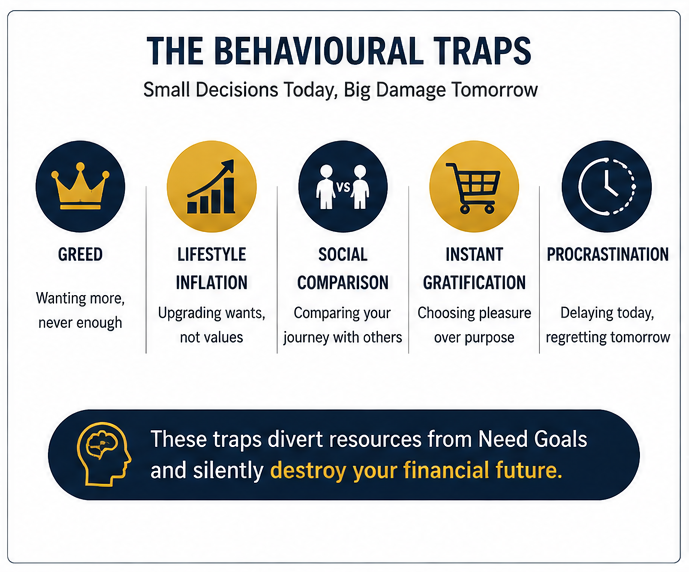
These behaviours encourage families to divert limited financial resources towards immediate wants while neglecting important future commitments.
Buying a larger house to match friends, upgrading lifestyle unnecessarily or spending heavily on luxury experiences may provide temporary satisfaction, but they often weaken the family’s ability to achieve long-term Need Goals.
Traditional financial planning recognises behavioural finance but offers very few practical mechanisms to improve investor discipline over the next twenty or thirty years.
Why Traditional Financial Planning Falls Short
Traditional financial planning provides excellent tools for managing investments through:
- Asset Allocation
- Risk Profiling
- Diversification
These techniques effectively manage Investment Volatility Risk.
However, they do not provide a structured framework to manage Behavioural Discipline Risk.
This is where the Stability Layer becomes the Missing Link.
The Stability Layer recognises that investor behaviour should be assessed just as systematically as investment risk. Once behavioural tendencies are understood, the financial plan can be structured to reduce the likelihood of emotional decisions disrupting long-term goals.

The Story of Mr. Dhimant Kapadia
Mr. Dhimant Kapadia had been my client for many years, and together we had prepared a financial plan for his family’s future.
Later, his company appointed a Certified Financial Planner for all employees, with the company bearing the cost. Mr. Kapadia decided to work with the planner and gradually stopped discussing financial planning with me. Assuming everything was on track, I continued servicing his existing policies.
A couple of years later, he contacted me for a loan against his insurance policies. He had found a piece of land in his hometown and wanted to purchase it immediately.
The loan was arranged.
Over the next few years, he neither repaid the loan nor serviced the interest regularly. He also stopped his SIPs and redeemed several long-term investments.
When his children’s higher education approached, he again required funds and had to borrow.
By the time he retired, he owned valuable real estate but lacked the liquidity needed to support his retirement lifestyle.
His financial plan had not failed because of poor investment selection.
It failed because disciplined execution was repeatedly sacrificed for short-term decisions.
Behaviour Can Be Designed
The encouraging news is that behaviour can be influenced.
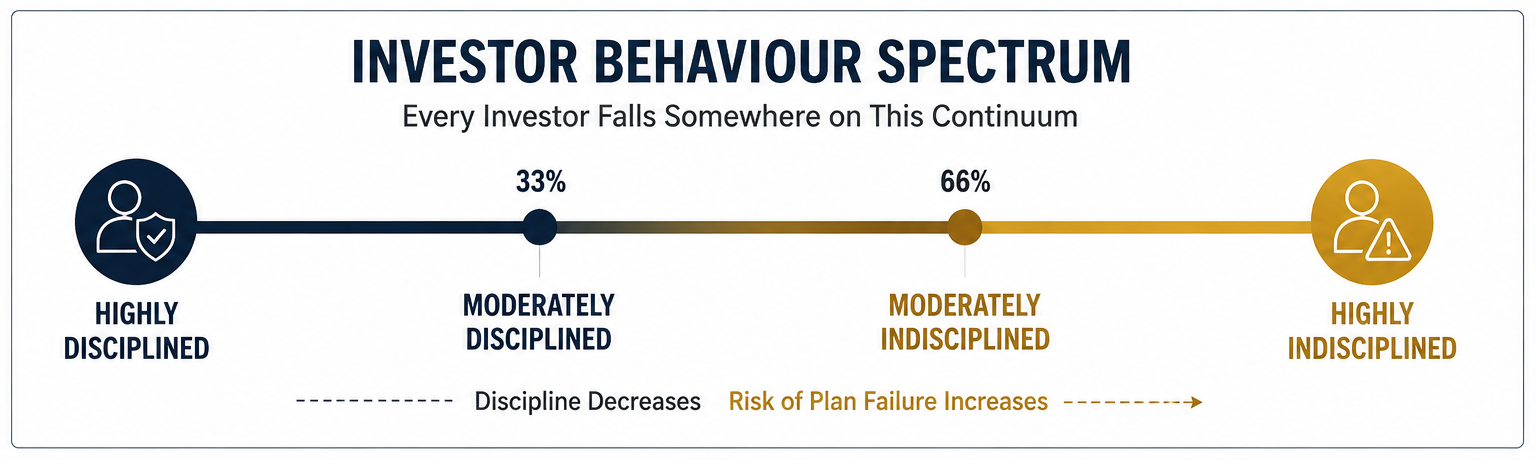
Just as financial planners use Risk Profiling to understand an investor’s ability to tolerate market fluctuations, I believe investors can also be assessed for their level of financial discipline.
They may broadly fall into four categories:
- Highly Disciplined
- Moderately Disciplined
- Moderately Undisciplined
- Highly Undisciplined
Once behavioural tendencies are identified, investment strategies can be structured to reduce the impact of emotional decisions.
No framework can eliminate behavioural mistakes completely.
But a well-designed framework can significantly improve the probability of long-term financial success by making disciplined behaviour easier to sustain.
That, I believe, is the Missing Link in Financial Planning.
Understanding behaviour is only the first step. The real question is: How do we design a financial life that naturally encourages disciplined decisions? In the next article, I introduce the 4C’s Philosophy, the next building block in The Missing Link in Financial Planning.
To go to the Next Blog Please click here. To go to blog 1 to start reading all articles please check the link below this link to Blog 1
IF THIS IS THE 1ST BLOG THAT YOU HAVE READ THEN YOU CAN GO AND READ ALL MY BLOGS FROM BLOG 1 ONWARDS HERE