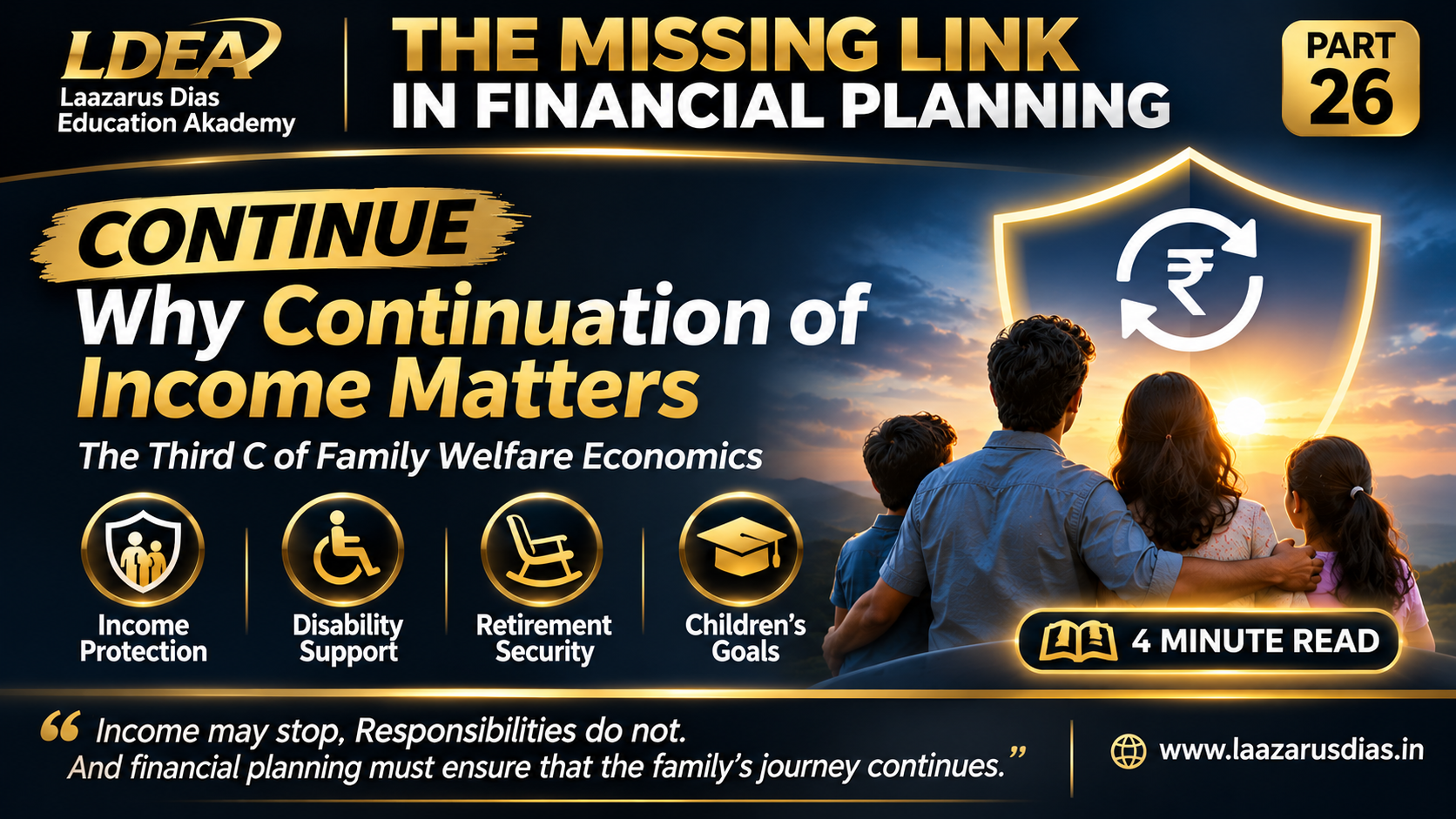
THE MISSING LINK IN FINANCIAL PLANNING – PART 26
November 10, 2026
CONSERVE: The Cost of Ignoring Liquidity
Can you imagine owning a beautiful property, admired by everyone who visits it, and yet struggling for almost one and a half years to find a buyer?
I experienced this personally. And it taught me a very important lesson about liquidity in financial planning.
A Property Everyone Admired
I owned a two-bedroom hall kitchen flat in Andheri, one of Mumbai’s prime suburbs. It was on the first floor and had something quite extraordinary: a 600-square-foot terrace.
The building had six shops on the ground floor, and the roof of these shops had been converted into a large terrace. We could accommodate almost 50 people there.
We regularly hosted church meetings in our home. Almost everyone who visited was amazed by the terrace. People would often say, “My God! This is a dream home!”
Naturally, I began to believe that selling this property would be relatively easy. After all, it was a unique property in a prime location, and everyone who saw it appreciated its value.

When My Assumption Went Wrong
By then, I had already purchased another residence and wanted to acquire an office. To fund the office purchase, I decided to sell the Andheri flat.
I estimated that six months would be sufficient to find a buyer and complete all the formalities.
Based on this assumption, I went ahead and signed the agreement to purchase the office. I arranged a bridge loan and planned to manage the EMIs on both properties for those six months.
But things did not go as expected.
Six months passed. No buyer.
One year passed. Still no buyer.
I circulated the message through our church, friends and social circles. I advertised on several property websites. Despite all these efforts, there was hardly any response.
Eventually, I had to reduce the asking price by ₹25 lakh from the prevailing market price to attract a buyer.
After considerable difficulty, I finally managed to sell the flat.
But by then, I had already spent more than a year paying two EMIs. The financial burden was well beyond what my income could comfortably support.
A property that everyone admired had become a source of considerable financial stress—not because it lacked value, but because I could not convert that value into cash when I needed it.

The Cost of Ignoring Liquidity
Fortunately, my situation was not a case of income stopping. My income continued.
But imagine the same situation if a family needed to sell its property to fund a child’s education, meet retirement requirements or support its living expenses following the death of the primary income earner.
What happens when the family needs money immediately, but most of its wealth is locked in an asset that may take months or even years to sell?
The family may be forced to accept a substantial discount, borrow money or compromise its standard of living.
This is an important distinction that every family must understand:
The value of an asset and its liquidity are two different things.
A property may be worth several crores on paper. But if it cannot be sold when money is urgently required, its market value does not solve the family’s immediate financial problem.
Conservation Is Also About Accessibility
The fourth C—CONSERVE—is about protecting the wealth and income we create.
But conservation is not simply about owning valuable assets, accumulating more wealth or ensuring appreciation. It is also about ensuring that the wealth remains accessible when it is needed.
Before committing substantial resources to property or other non-liquid assets, a family must first address its Need Goals and financial continuity through appropriate liquid financial assets.
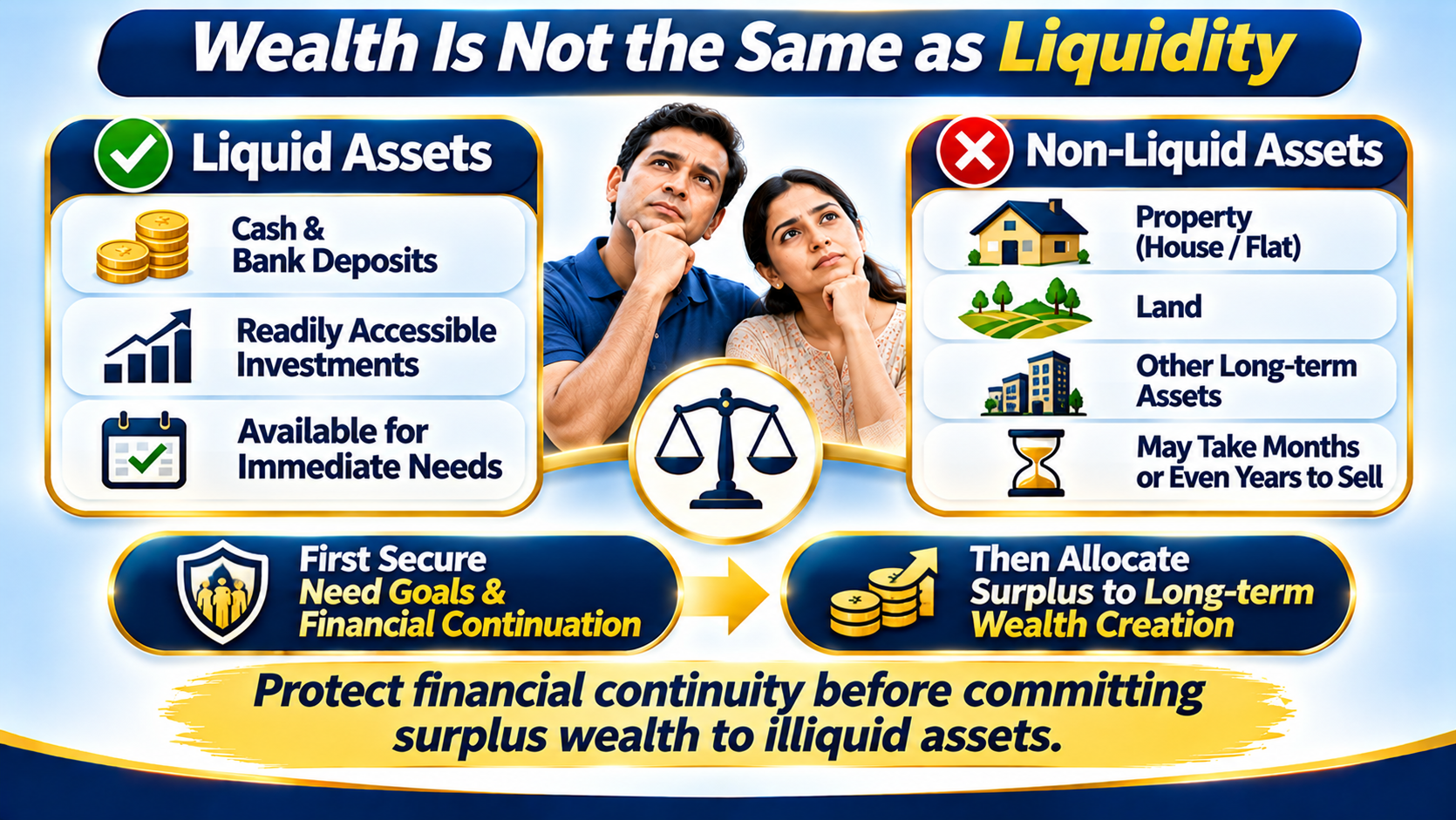
Fixed-time commitments such as children’s education, retirement requirements and emergency needs should not depend entirely on the sale of property or other assets that may take time to liquidate.
Once the family’s essential needs and financial continuity are adequately secured, surplus resources can be directed towards long-term wealth creation, property and other assets that support its Want Goals.
The sequence matters.
The Third C Must Never Be Compromised by the Fourth C
Let us recall the distinction between the third and fourth C’s:
CONTINUE protects what the family needs. It ensures that the family’s standard of living and essential financial commitments can be maintained even when regular income stops.
CONSERVE builds, protects and preserves what the family wants. It focuses on wealth creation, wealth protection and wealth propagation.
Both are important, but the fourth C should never compromise the third C.
A family should not put its financial continuity at risk by committing money required for essential needs into assets that may not be easily liquidated.
I learnt this lesson through my own experience. I had underestimated the time required to sell a property and had committed myself to a financial obligation based on an assumption that did not materialise.
Don’t allow the appreciation of an asset to blind you to its liquidity.
Because in financial planning, having wealth is important. Having access to it when you need it can be even more important.
In our next article, we move to another important dimension of financial planning: Can Behavioural Risk Be Measured?
If you’re reading this Blog series for the first time, please click the link below to go to the first article, then read each subsequent blog, with links provided below each one.