
THE MISSING LINK IN FINANCIAL PLANNING – Part 19
September 23, 2026
Wealth Transfer — More Than Passing on Assets
How to Transfer Wealth Without Losing Its Value or Purpose
In the previous article, we explored the power of generational wealth and how one generation can create a stronger financial foundation for the next.
But creating and conserving wealth raises another important question:
What happens when that wealth has to be transferred to the next generation?
We often think of wealth transfer as a simple event.
Parents accumulate wealth.
Children inherit it.
But wealth transfer is much more than transferring ownership of assets.

The real challenge is to ensure that the wealth survives the transfer—and continues to serve the purpose for which it was created.
Wealth Transfer Is Not the Same as Inheritance
Inheritance is the legal or financial transfer of assets from one generation to another.
Wealth transfer is broader.
It involves transferring:
- Assets
- Ownership
- Control
- Responsibility
- And, most importantly, purpose
A family may have built substantial wealth through years of discipline, sacrifice and long-term investing.
But the moment that wealth passes to the next generation, its future can take a very different direction.
The assets may be preserved.
They may be grown.
Or they may gradually be consumed.

The difference often has little to do with the amount of wealth inherited.
It has much more to do with how the transfer is planned and how the wealth is understood by the person receiving it.
Preserving the Wealth
The first objective of wealth transfer is obvious:
Preserve what has been created.
This requires more than simply knowing the value of the family’s assets.
A family may own property, shares, businesses, gold and other investments. But if ownership is unclear, succession has not been planned, or adequate liquidity is not available, even substantial wealth can become difficult to manage.
Consider a simple situation.
A family owns a valuable property and several long-term investments. After the parents are no longer around, the children need money for different purposes.
One child wants to sell the property.
Another wants to retain it.
A third may need immediate liquidity.
An asset that represented security and wealth for one generation can become a source of disagreement for the next.
The problem was not the asset.
The problem was the absence of a plan for transferring and managing it.
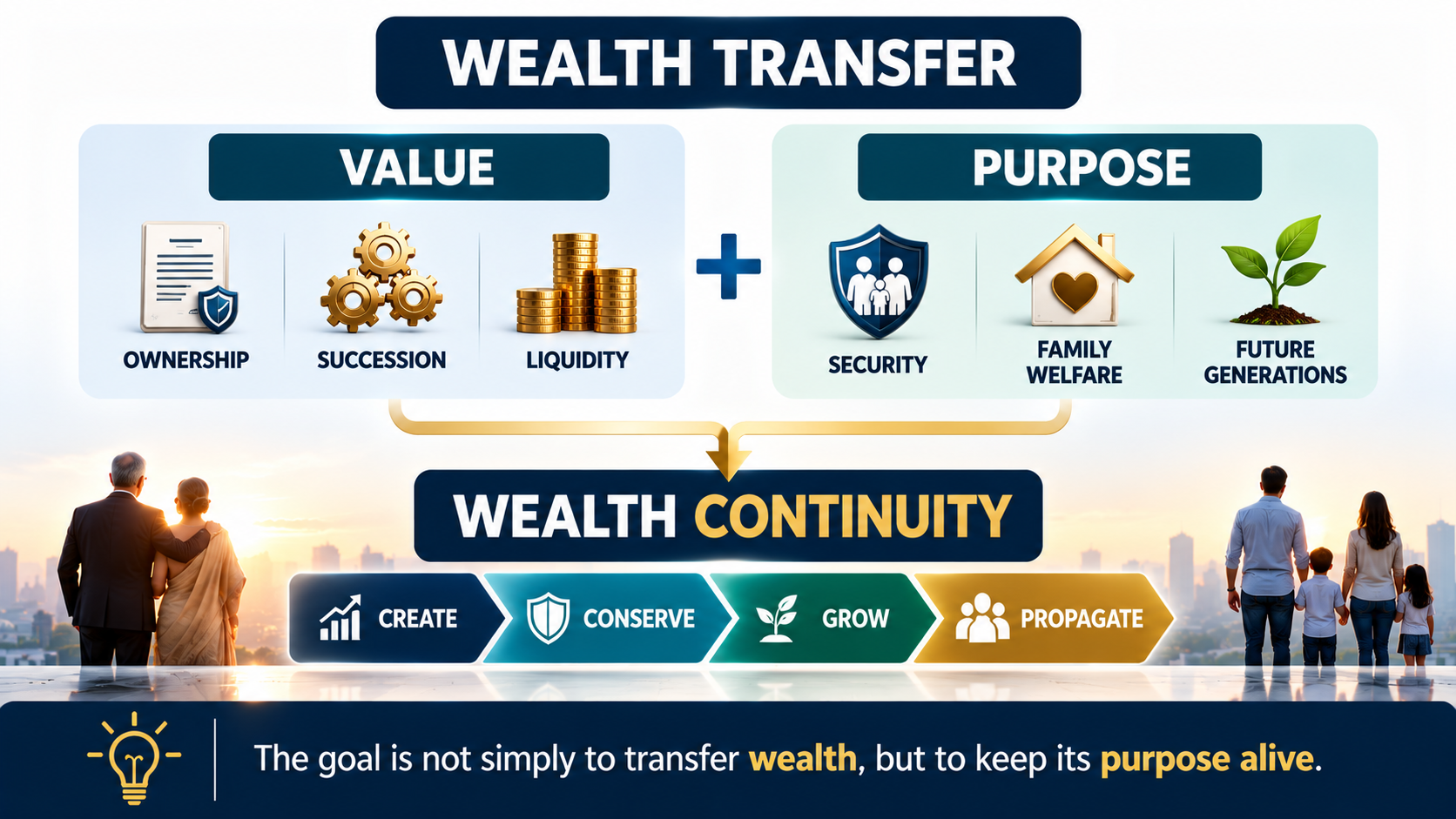
This is why wealth transfer needs to consider ownership, succession, liquidity and the family’s long-term objectives.
Preserving the Purpose
But there is another, less visible dimension.
Why was the wealth created in the first place?
Was it created to provide financial security for the family?
To fund children’s education?
To provide independence in retirement?
To create opportunities for future generations?
Or simply to build a stronger financial foundation for the family?
If the next generation receives the assets but not the purpose behind them, the wealth can easily become just another source of money to spend.
This is where the philosophy of the 4C’s becomes relevant.
The wealth created through the first C — Creation — and protected through the subsequent stages should ultimately be Conserved and Propagated, rather than automatically converted into consumption.
The objective is not to prevent the next generation from enjoying the wealth.
It is to ensure that consumption does not destroy the productive base created by the previous generation.
Wealth Is a Responsibility, Not Just an Asset
This changes the way we should look at inheritance.
Instead of asking:
“How much will my children inherit?”
we should also ask:
“What will my children do with what they inherit?”
A ₹10 crore productive asset that continues generating wealth for the family may create far greater value over several generations than the same ₹10 crore gradually consumed.
This is why the transfer of wealth should ideally include not only the transfer of assets, but also the transfer of financial understanding and responsibility.
The first generation creates.
The next generation must conserve and grow.
And the following generation should have the opportunity to build on that foundation.
From Wealth Transfer to Wealth Continuity
This brings us back to the larger philosophy of The Missing Link in Financial Planning.
Financial planning is not complete when an individual achieves financial freedom.
It is not complete when wealth is accumulated.
And it is not complete when assets are transferred to the next generation.
The real measure is whether the wealth can continue to serve the family across generations.
That is the difference between leaving behind assets and creating a legacy.
A successful wealth transfer should therefore preserve two things:
The value of the wealth.
And the purpose behind the wealth.
Because wealth created by one generation should ideally not become a reason for the next generation to start again from zero.
Wealth is created by one generation, conserved through another, and given the opportunity to grow across generations.
And this brings us back to a fundamental question in financial planning: Before wealth can be transferred to the next generation, have we first secured the financial needs of the present and the future?
Because wealth transfer is meaningful only when the family’s own Present Gap and Future Gap have been properly addressed.
In the next article, we will explore why the right sequence in addressing the Present Gap and Future Gap matters—and how getting that sequence wrong can affect the entire financial journey.
If you’re reading this Blog series for the first time, please click the link below to go to the first article, then read each subsequent blog, with links provided below each one.